
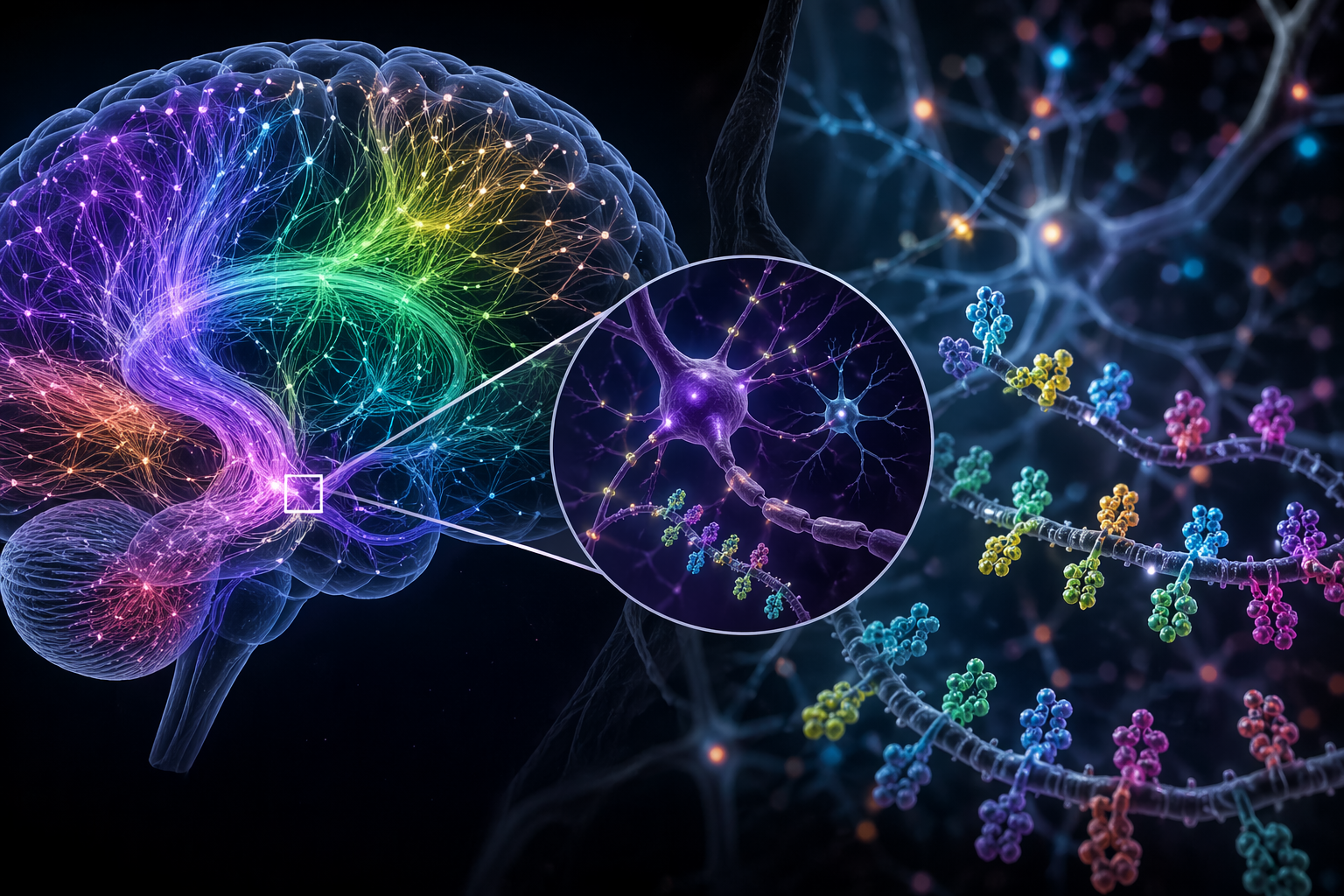
In April 2026, neuroscience researchers achieved a breakthrough that opens entirely new windows into understanding how the brain works. According to ScienceDaily, scientists developed a cutting-edge brain mapping technique using RNA “barcodes” to map how neurons connect, capturing thousands of synaptic connections with single-synapse precision.
Key Insight: The RNA barcode technique allows researchers to identify and map individual synaptic connections between neurons with unprecedented resolution, revealing neural circuits previously impossible to visualize.
The human brain contains roughly 86 billion neurons, each connected to thousands of other neurons through connections called synapses. These 100 trillion or more synaptic connections form the physical basis of thought, memory, personality, and consciousness. Yet until recently, neuroscientists lacked tools to comprehensively map these connections in intact brains.
The challenge has always been one of scale and resolution. Traditional methods like electron microscopy can visualize individual synapses but only in tiny tissue samples. Behavioral studies can track neural activity but can’t determine which neurons are connected. The new RNA barcode approach bridges this gap, enabling systematic mapping of synaptic architecture across entire brain regions.
How Brain Mapping with RNA Barcodes Reveal Neural Connections
The technique works through a remarkably elegant molecular approach. Researchers engineer neurons with unique RNA sequences, like unique product barcodes in a grocery store. When two neurons form a synapse, their unique RNA barcodes mix and become detectable in the connecting region. By sequencing these RNA mixtures from different brain areas, researchers can reconstruct which neurons connect to which.
The power of this approach lies in its scalability. Unlike electron microscopy, which requires painstaking slice-by-slice imaging, the RNA barcode method works at the molecular level, enabling analysis of millions of connections simultaneously. According to ScienceDaily’s detailed reporting, the initial application successfully mapped thousands of neural connections in laboratory models with exquisite precision.
Each neuron is labeled with a unique RNA sequence during development. When neurons form synapses, these sequences come into proximity. By analyzing which sequences are found together in neural tissue, researchers create a map of connectivity. It’s like identifying which products sat next to each other on store shelves by analyzing barcode proximity, but at the molecular level in the brain.
Technical Innovation: The method combines genetic labeling with sequencing technology, allowing researchers to achieve resolution that was theoretically possible but practically unachievable with previous methods.
The research team enhanced the basic technique with several innovations. They developed ways to distinguish strong synapses from weak ones, to identify the direction of information flow (which neuron is sending, which receiving), and to map multiple connection types simultaneously. These enhancements make the technique far more informative than simple connectivity mapping.
Importantly, the method works in intact brains, not just brain slices. This preserves the natural architecture and organization of neural circuits. Studying brain connectivity in its natural state provides insights impossible to achieve from isolated tissue samples.
Implications for Understanding Brain Development and Disease
The ability to comprehensively map neural circuits will revolutionize our understanding of how the brain develops, how learning changes connectivity, and how neurological diseases disrupt normal wiring. Conditions like autism, schizophrenia, and dyslexia are thought to involve abnormal neural connectivity patterns. The new mapping technique could reveal exactly which connections go awry in these conditions.
For autism research, this is particularly significant. According to neuroscientists from Nature.com, the condition likely involves both excessive and insufficient connectivity in different brain regions. The RNA barcode technique could precisely identify these aberrant connections, potentially revealing new therapeutic targets.
The technique also has profound implications for understanding learning and memory. When we learn something new, synaptic connections strengthen, new synapses form, and old ones are pruned away. By mapping connectivity patterns before and after learning, researchers can finally see exactly which connections encode memories and how learning physically reorganizes the brain.
Neuroscience Impact: This mapping capability could accelerate understanding of how experience literally rewires the brain, fundamental to comprehending learning, recovery from brain injury, and therapeutic brain stimulation.
Stroke recovery is another promising application. When stroke damages a brain region, surviving neurons can sometimes form new connections that restore lost function. The RNA barcode technique could reveal which new connections are most therapeutic, potentially guiding rehabilitation strategies. Understanding the connectivity changes associated with successful recovery could inform future treatments.
Neurodegenerative diseases like Alzheimer’s and Parkinson’s could also benefit from this research. These conditions involve progressive loss of neurons and connections. The new mapping technique could reveal which connectivity patterns are preserved longest and which are most vulnerable, guiding therapeutic development.
Read More: AI Can Predict Melanoma Up to Five Years Before Diagnosis
From Research Tool to Clinical Application
While the current application focuses on laboratory animal brains, the technique’s principles could eventually extend to human tissue samples, post-mortem brains from patients with neurological conditions, or surgically removed tissue. Understanding the actual wiring changes in human disease would be transformative for developing treatments.
Combining the RNA barcode approach with other imaging and electrophysiological techniques creates unprecedented power for understanding brain function. Researchers can now ask questions like: “Which neurons are connected to this visual neuron, and what are their firing patterns?” The answers require integrating multiple types of data, and modern computational approaches make this feasible.
The team is already applying the technique to map development of sensory brain regions, learning-related changes in memory circuits, and alterations in disease models. Each application reveals new principles of how neural circuits are organized.
Research Potential: The technique enables neuroscientists to finally ask comprehensive questions about neural architecture that have been limited by technological constraints for decades.
The international neuroscience community is responding with excitement. Dozens of labs worldwide are licensing the technology or developing related approaches. This competitive environment accelerates methodological refinement and expands applications.
Limitations and Future Directions
Despite its power, the RNA barcode technique has limitations. Currently, it requires killing the tissue for analysis, researchers can’t map connectivity in living brains repeatedly over time. Future versions might overcome this through non-invasive imaging of RNA signals, though that remains challenging.
The method also works best in genetically modified organisms where the barcode system can be introduced. Applying it to wild-type brains requires alternative labeling strategies still under development. These technical limitations will likely be overcome within the next 5-10 years.
Another consideration involves scale. While the technique maps thousands of connections, the brain contains trillions. Complete connectomes, wiring diagrams of entire brains, remain years away. However, strategic mapping of key circuits is immediately valuable and increasingly feasible.
Read More: Reversible Male Contraception: The End of Hormone-Based Contraception
The Broader Significance for Neuroscience
The 2026 RNA barcode breakthrough exemplifies how technological innovation drives scientific progress. For decades, neuroscientists have theorized about the importance of understanding brain connectivity. The barrier wasn’t conceptual, it was practical. New tools enable researchers to finally test these long-standing theories empirically.
This breakthrough joins other recent advances, advanced microscopy, functional imaging, optogenetics, and computational modeling, in creating a new era of neurobiological understanding. The convergence of these technologies promises unprecedented insights into how our brains work, how they develop, and how they fail in disease.
For patients with neurological conditions, these advances offer hope. Better understanding of disease mechanisms typically precedes better treatments. The RNA barcode technique accelerates that progression, potentially bringing therapies for currently incurable neurological conditions closer to reality.
For more science news and research coverage, visit the Science section at bdesk.news.

Michaela Reeds is an investigative journalist and reporter with a focus on politics, science, and technology. She brings clarity to complex issues, translating policy developments, scientific breakthroughs, and technological innovations into compelling stories for a broad audience. She is known for her dedication to accuracy, transparency, and in‑depth reporting.