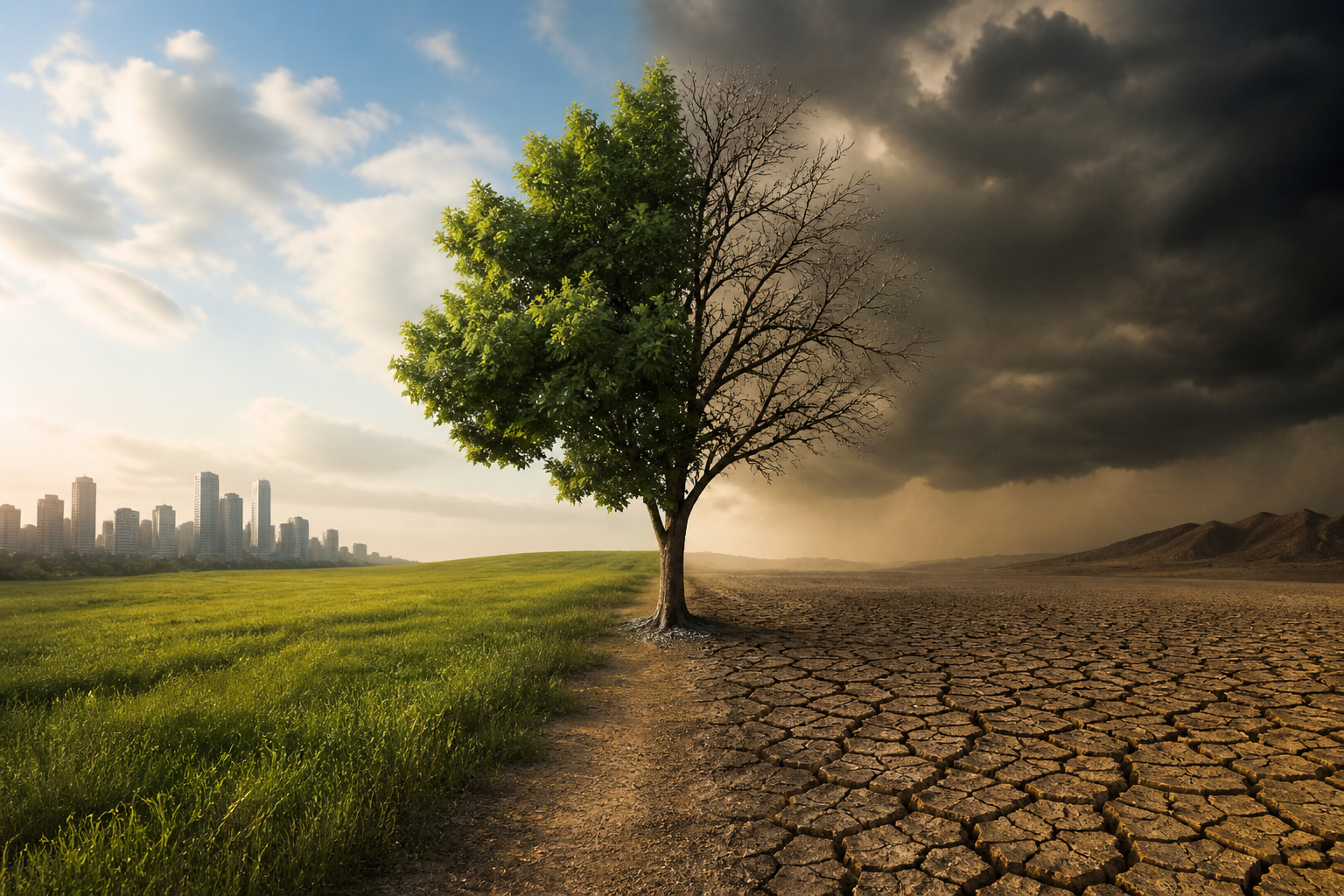
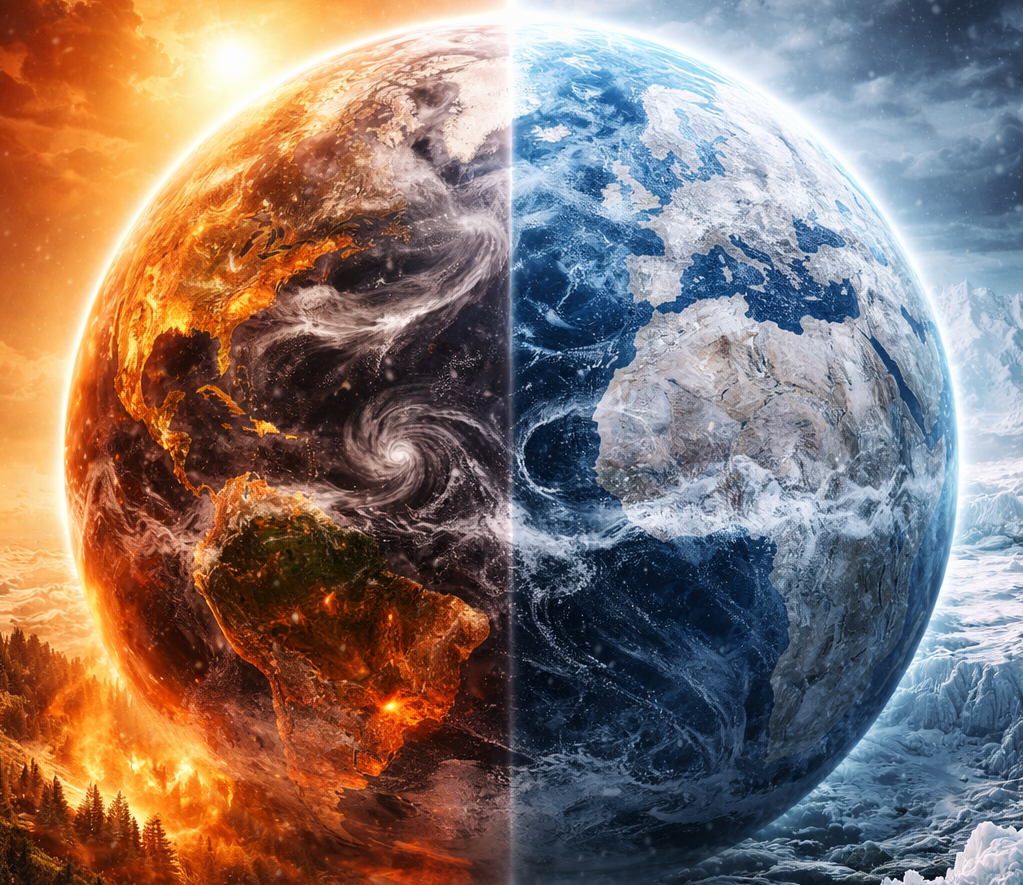
Climate change has become one of the defining issues of our time. Politicians around the world frequently debate, how to respond to global warming. Some push for aggressive regulations and net‑zero emissions goals. Others question the degree of human influence or the trade‑offs with economic growth.
At the same time, scientists studying Earth’s deep climate history are uncovering the rhythms of natural climate change that have shaped ice ages and warm periods over hundreds of thousands of years. A recent wave of research suggests that Earth’s long‑term orbital cycles could set the stage for another glacial period in roughly 10,000–11,000 years, but only in the absence of human interference. That timeline is far removed from the urgent challenges facing humanity today.
At first glance, it might seem contradictory to talk about global warming now and a future ice age later. But these are two different processes operating on very different timescales and understanding both is crucial for informed public discussion and effective policy.
In this article, we’ll explore:
- What mainstream science says about current global warming
- How natural ice age cycles work and why the next one is thousands of years away
- How human emissions are already altering Earth’s climate trajectory
- Why political discussions about climate vary so widely
- What this all means for policy and human race
Let’s begin with the fundamentals.
1. The Scientific Consensus on Global Warming
There is strong, long‑standing consensus among climate scientists that Earth’s climate is warming and that human activities, especially the burning of fossil fuels, are the primary cause of recent warming.
According to NASA’s scientific consensus page:
- Earth’s average surface temperature has risen significantly over the past century.
- The past decade includes the warmest years on record.
- Multiple independent lines of evidence, from melting ice sheets to rising sea levels, consistently point to a warming climate.
Moreover, another NASA page explains that about 97 % of actively publishing climate scientists agree that humans are causing global warming. This level of agreement is comparable to the scientific certainty that gravity governs falling objects, it is rooted in extensive, peer‑reviewed research and decades of data. (See: NASA FAQ on scientific agreement)
This scientific foundation underlies major global assessments, including those from the Intergovernmental Panel on Climate Change (IPCC) — a body representing thousands of climate scientists worldwide.
2. Natural Ice Age Cycles – What They Are and How They Work
While human‑driven climate change is the dominant factor shaping today’s climate, Earth’s climate has also changed drastically over geological time due to natural processes. One of the most well‑studied components of Earth’s natural climate variability is what are known as ice age cycles.
Ice ages are extended periods when large ice sheets grow and cover significant land areas, followed by warm interglacial periods when ice retreats. These cycles have occurred repeatedly over the past million years.
The key drivers of these cycles are Milankovitch cycles, named after Serbian mathematician Milutin Milankovitch, who first theorized how small changes in Earth’s orbit and tilt affect climate:
- Eccentricity: the shape of Earth’s orbit around the Sun fluctuates over ~100,000‑year cycles.
- Obliquity (axial tilt): the tilt of Earth’s axis varies from about 22.1° to 24.5° over ~41,000 years.
- Precession: Earth “wobbles” on its axis over ~23,000 years, changing when seasons occur relative to distance from the Sun.
These variations change how much solar energy different parts of Earth receive over long periods. When summer sunlight in the Northern Hemisphere decreases enough, winter snow doesn’t fully melt, slowly allowing ice sheets to grow. Over thousands of years, this can culminate in a glacial period.
For a detailed scientific explanation of these mechanisms, see NASA’s overview of Milankovitch cycles.
3. Is an Ice Age Coming Soon? What the Science Actually Says
A common misunderstanding is that scientists are predicting an ice age soon. In reality, research suggests that under natural conditions alone, without human influence, Earth’s long‑term orbital patterns would next favor a glacial period in roughly 10,000 to 11,000 years. This estimate comes from work that matches past climate changes to orbital variations and deep‑sea temperature records.
A 2025 summary of this research explains that, based on past patterns and orbital timing, Earth’s climate would eventually move toward conditions favorable for glaciation, but on a far longer timescale than typical human planning horizons. (See: LiveScience article summarizing the research)
Additionally, scientific reviews of glacial and interglacial cycles confirm that these fluctuations have occurred many times in Earth’s history and are paced by Milankovitch forcing over tens to hundreds of thousands of years. (See: Wikipedia overview of Milankovitch cycles)
The key takeaway here is that the natural climate system does include slow, predictable cycles of cooling and warming, but these operate over millennia, not decades or centuries.
Read More: Record Close-Up Photos of the Sun: How NASA’s Parker Solar Probe Changed Solar Science
4. How Human Emissions Are Already Altering Earth’s Climate Trajectory
Although orbital cycles might eventually lead to cooling many thousands of years from now, the current climate system is not behaving as it would under natural forces alone. Human activities, especially the burning of fossil fuels, have dramatically increased concentrations of carbon dioxide and other greenhouse gases in Earth’s atmosphere.
Today’s CO₂ levels are higher than at any point in at least 800,000 years, based on ice core records. Rising greenhouse gases trap more heat in the atmosphere, leading to the observed warming trend that scientists have documented.
Importantly, recent research shows that human‑driven warming may delay the next natural glaciation. Ironically, this means that the warming caused by human emissions, the same warming that contributes to climate extremes today, could push back the onset of a future ice age that would otherwise arise under natural orbital rhythms.
In this sense, human influence on climate is powerful enough to override some long‑term natural variations, a point that underscores both the magnitude of our impact and the importance of understanding climate dynamics holistically.
For a broad scientific overview of ice ages and the role of human influence on climate cycles, see the Wikipedia entry on ice ages.
5. Why Political Messaging on Climate Varies So Widely
With the scientific backdrop in place, warming now, slow natural cycles later, you might wonder why political discussions about climate are so uneven and contentious.
The short answer is that political debate is shaped by factors that differ from scientific consensus. Scientists evaluate evidence and revise conclusions based on data; political actors balance scientific information with economic, ideological, and electoral considerations.
Partisan Divides and Climate Perception
In countries like the United States, public opinion on climate change often splits along political lines. A 2016 Pew Research Center survey found stark differences in how major political groups view climate science, with one side expressing strong confidence in scientific findings and the other showing skepticism.
These divisions shape political rhetoric. Some conservative or right‑wing politicians and commentators have questioned the severity of human impact on climate or have prioritized short‑term economic considerations. For example, a series of news reports have covered efforts by some U.S. states and politicians to challenge or roll back climate regulations such as the Environmental Protection Agency’s endangerment finding on greenhouse gases. (See: The Guardian on U.S. political debates)
In the United Kingdom, similarly polarized narratives in media and politics have shaped resistance or pushback against net‑zero emissions plans, even though polling shows broad public support for environmental action. (See: The Guardian on UK climate narratives)
At the same time, many other political leaders and international officials emphasize climate action not as a choice but as a response to overwhelming scientific evidence. For instance, top scientists and policymakers frequently stress that achieving net‑zero emissions is essential to avoid the worst impacts of warming. (See: Financial Times coverage of scientific urgency)
The Gap Between Policy and Science
The result of these dynamics is a landscape in which political messaging on climate can vary dramatically: from declarations of urgent action grounded in science to skepticism or rejection of scientific consensus framed around economic or ideological interests.
This gap doesn’t reflect a lack of scientific evidence. Rather, it reflects the ways in which political systems process, interpret, and communicate scientific information, often through the lens of short‑term priorities and electoral incentives.
Read More: The Glowing Plants That Could Change How We Light Our Cities Forever
6. Reconciling “Warming Now” and “Ice Age Later”
One of the biggest sources of misinterpretation in public discourse is the mixing up of short‑term climate change with long‑term natural cycles.
- Global warming refers to the observed increase in average global temperatures over recent decades, a trend tied closely to human greenhouse gas emissions.
- Ice ages are natural, slow shifts over tens of thousands of years driven by orbital mechanics.
These two are not in conflict. In fact, the reason scientists can talk about a future ice age thousands of years from now is because we understand both mechanisms: human perturbations affecting short‑term climate and orbital variations affecting long‑term climate.
Importantly, discussing a future ice age doesn’t undermine concern about current warming. These are different processes operating at different timescales, and both deserve accurate interpretation in public discussion.
Global warming is real, measurable, and largely human‑driven
This is the scientific consensus, not a political position.
Earth’s climate has natural long‑term cycles, but they play out over millennia
Ice age cycles are important for understanding Earth’s climate history, not for short‑term climate forecasts.
Human emissions have already altered the climate system significantly
Greenhouse gases are warming the planet now, and models suggest this influence could delay future natural cooling.
Political debate does not always align with scientific consensus
Political messaging varies widely across regions, parties, and systems, often reflecting economic, ideological, or cultural priorities rather than universally accepted science.
Conclusion
The conversation around climate change is complex because it spans different timescales, scientific domains, and political frameworks. While some politicians debate the causes and urgency of climate action, the scientific evidence on current global warming is clear and robust. At the same time, Earth’s long‑term natural cycles, driven by orbit, tilt, and cosmic rhythms, point toward climate variations far beyond any human lifetime.
Understanding both the present and the distant future gives us a fuller picture of Earth’s climate system. What’s happening now, rapid warming driven by human activities, is immediate and consequential. What might happen tens of thousands of years from now under natural orbital cycles is fascinating and scientifically significant, but it does not negate the urgency of acting on the science that affects us today.
In fact, the very fact that human influence can disrupt Earth’s natural cycles underscores how powerful and consequential our choices are. For better or worse, humans are now part of the climate story, not as passive observers, but as active participants shaping the climate of our own era.
For more science news and research coverage, visit the Science section at bdesk.news.

Ethan R. Brooks is a journalist with over 11 years of experience, specializing in finance, politics, and breaking news. He delivers timely, accurate reporting on market trends, economic developments, and major political events, helping readers stay informed on the stories that matter most.