

Disclaimer
Dividend investing has quietly created more long-term wealth than most flashy strategies. While growth stocks dominate headlines, seasoned investors understand that consistent dividend-paying companies are the backbone of real financial independence.
In 2026, that truth hasn’t changed, if anything, it’s more relevant. With market volatility, geopolitical tensions, and uncertain interest rates, investors are once again turning to reliable passive income streams.
According to data cited by The Motley Fool, dividend stocks have historically outperformed non-dividend payers over long periods, delivering both income and capital appreciation.
This article breaks down 5 of the best dividend stocks for passive income in 2026, selected based on:
- Dividend yield and sustainability;
- Cash flow strength;
- Long-term growth potential;
- Track record of dividend increases.
Why Dividend Stocks Still Matter in 2026
Before jumping into the list, let’s get something straight: not all dividend stocks are equal.
A high yield alone means nothing. In fact, it can be a warning sign.
Serious investors focus on:
- Payout ratio (ideally under 60%)
- Free cash flow
- Dividend growth history
- Business stability
Research highlighted by Kiplinger shows that companies with long histories of dividend increases, often called Dividend Aristocrats, tend to offer lower volatility and stronger long-term returns.
That’s the mindset behind the picks below.
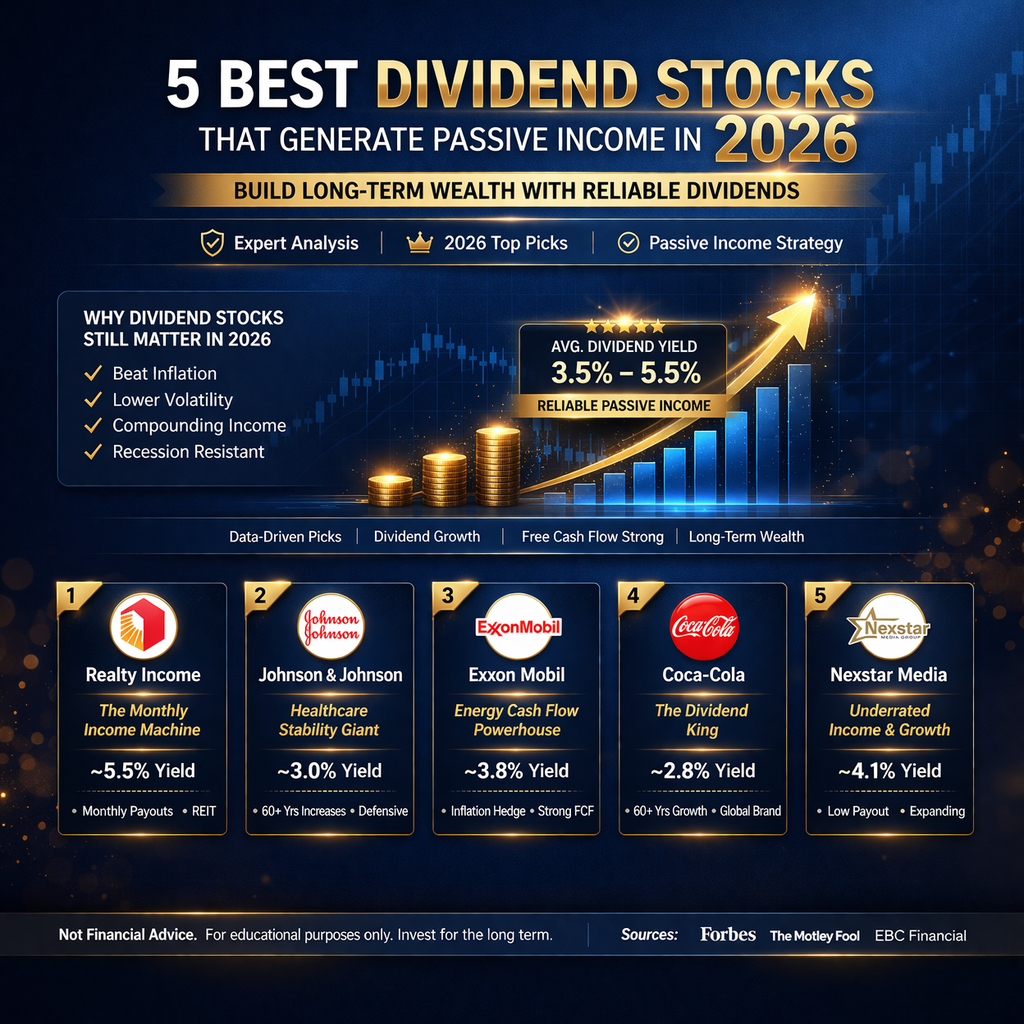
1. Realty Income (O) | The Monthly Income Machine
Why it stands out
If you want true passive income, this is one of the closest things to “set and forget.”
Realty Income is famous for paying monthly dividends, not quarterly. That alone makes it extremely attractive for income-focused investors.
Key highlights:
- Dividend yield: ~5%–5.7%;
- Monthly payouts;
- 25+ years of dividend growth;
- Real estate investment trust (REIT).
According to analysis from EBC Financial Group, Realty Income benefits from long-term lease agreements and predictable cash flow, making it one of the most reliable income stocks globally.
The long-term thesis
This company owns thousands of commercial properties leased to stable tenants. Even during downturns, rent keeps flowing.
Bottom line:
If your goal is consistent, predictable income, this is a cornerstone stock.
2. Johnson & Johnson (JNJ) | Stability Over Hype
Why it stands out
Johnson & Johnson represents something rare in markets today: extreme stability.
Key highlights:
- Dividend yield: ~3%;
- 60+ years of dividend increases;
- Global healthcare giant.
Healthcare is one of the most defensive sectors. People don’t stop needing medicine during recessions.
Financial analysts consistently rank JNJ as a “core dividend holding” thanks to its reliable earnings and diversified pharmaceutical business.
The long-term thesis
This is not a high-yield play, it’s a wealth preservation + income compounder.
Bottom line:
If you want sleep-at-night investing, this belongs in your portfolio.
3. Exxon Mobil (XOM) | Cash Flow Powerhouse
Why it stands out
Energy stocks are often misunderstood. But Exxon Mobil has transformed into a cash-generating machine.
Key highlights:
- Dividend yield: ~3.5%–4%;
- Strong free cash flow;
- Inflation hedge.
After restructuring post-2020, Exxon now operates with lower break-even costs, meaning it can remain profitable even if oil prices drop.
According to sector analysis, its dividend is supported by disciplined capital allocation and strong earnings visibility.
The long-term thesis
Energy demand isn’t disappearing anytime soon. Even in a renewable transition, oil remains essential.
Bottom line:
A solid mix of income + inflation protection.
4. Coca-Cola (KO) | The Dividend King
Why it stands out
Coca-Cola is one of the most iconic dividend stocks in history.
Key highlights:
- Dividend yield: ~2.5%–3%;
- 60+ consecutive years of increases;
- Global brand dominance.
This is the textbook example of a Dividend King, a company that has raised its dividend for over 50 years.
Consumer staples companies like Coca-Cola remain stable because demand is constant, even during economic downturns.
The long-term thesis
You’re not buying explosive growth, you’re buying reliability and compounding.
Bottom line:
A foundational stock for long-term passive income portfolios.
5. Nexstar Media Group (NXST) | Underrated Income + Growth
Why it stands out
Nexstar Media Group is less known but that’s where opportunity often lies.
Key highlights:
- Dividend yield: ~4.1%;
- Strong earnings growth outlook;
- Low payout ratio (~45%).
According to Forbes, Nexstar combines solid yield with aggressive expansion plans, including acquisitions expected to boost free cash flow significantly.
The long-term thesis
Unlike traditional dividend stocks, Nexstar offers both:
- Income;
- Growth potential.
Bottom line:
A smart pick if you want dividends and capital appreciation.
Read More: Beginner’s Guide to Investing in 2026: Stocks, ETFs, and Crypto Explained
Dividend Strategy for 2026 (What Most People Get Wrong)
Chasing High Dividend Yields
One of the most common traps in dividend investing is going after stocks with extremely high yields, often 10% or more. While this may look attractive on the surface, it usually signals underlying problems. In many cases, these payouts are unsustainable and can indicate financial distress, declining earnings, or an impending dividend cut.
Overlooking Dividend Growth
Focusing only on current yield and ignoring growth is a costly mistake. A stock with a modest 3% yield that consistently increases its dividend can outperform a stagnant 7% yield over time. Long-term wealth in dividend investing comes from compounding income, not just high upfront payouts.
Failing to Diversify
Relying too heavily on a single sector exposes your income stream to unnecessary risk. Strong dividend portfolios are built across multiple industries, typically including:
- REITs for steady income;
- Consumer staples for stability;
- Energy stocks as an inflation hedge;
- Growth-oriented dividend companies for capital appreciation.
Diversification ensures your passive income remains resilient across different market conditions.
Sample Passive Income Portfolio (2026)
Here’s a simple structure based on current market logic:
- 25% REITs (e.g., Realty Income)
- 25% Consumer staples (Coca-Cola)
- 20% Healthcare (Johnson & Johnson)
- 15% Energy (Exxon Mobil)
- 15% Growth dividend stocks (Nexstar)
This kind of allocation balances:
- Income;
- Stability;
- Growth.
What Makes a Dividend Stock “Safe”?
- Consistent dividend growth (10+ years);
- Strong free cash flow;
- Low to moderate payout ratio;
- Defensive industry positioning.
Read More: Stock Buybacks: Why This $800 Billion Practice Might Be Distorting Your Investments
Final Thoughts: Building Real Passive Income
Here’s the truth most “get rich quick” finance content won’t tell you:
Dividend investing is not exciting, but it works if you consistently invest in high-quality dividend stocks:
- Your income grows;
- Your portfolio compounds;
- Your risk decreases over time.
For more finance reporting and in-depth analysis, visit the Finance section at bdesk.news.

Ethan R. Brooks is a journalist with over 11 years of experience, specializing in finance, politics, and breaking news. He delivers timely, accurate reporting on market trends, economic developments, and major political events, helping readers stay informed on the stories that matter most.

