
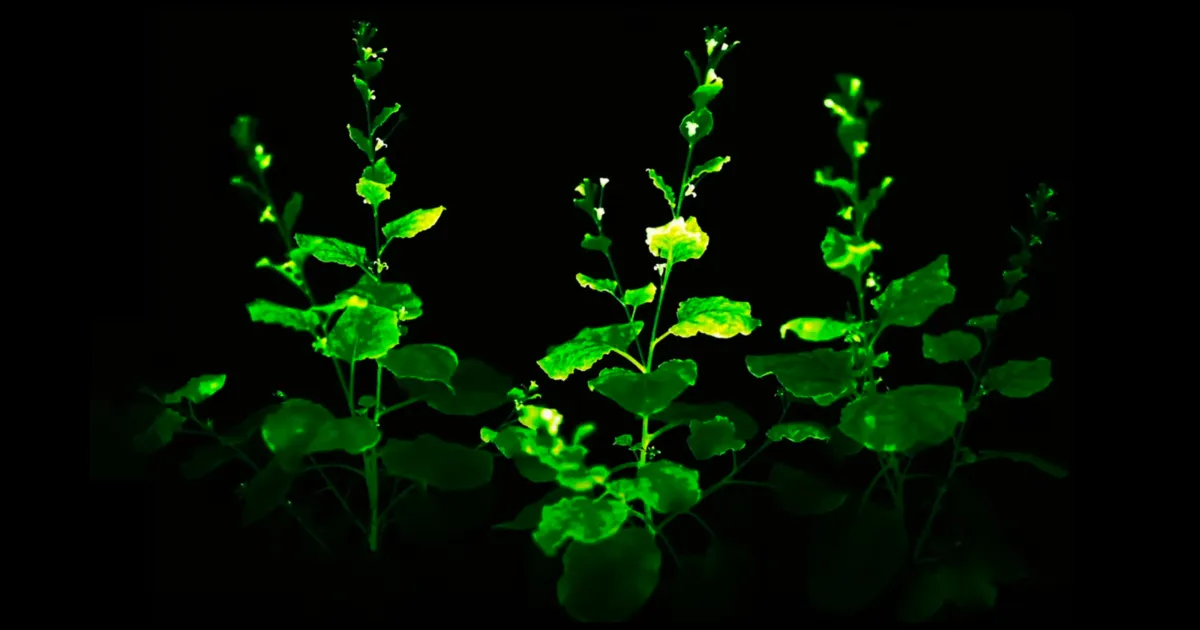
Walk through a park at night and you expect streetlamps, buzzing and bright. But what if the light came from the plants themselves? What if the trees along the path glowed softly, the way fireflies do on a warm summer evening? That is no longer the stuff of science fiction. Chinese scientists have just taken a major step toward making glowing plants real.
Researchers have unveiled genetically engineered plants capable of glowing in the dark, a breakthrough that could transform urban lighting, tourism, and sustainable design. According to euronews, at a public showcase in Beijing, flowers sat under no spotlight, plugged into no power source, and yet they glowed.
A Childhood Dream Turned Into Scientific Mission
Behind the discovery is a story that is hard not to find moving. Dr. Li Renhan, lead researcher and founder of Chinese biotech startup Magicpen Bio, recalled growing up without electricity in the countryside. As a boy, he would lie in his grandfather’s bamboo grove at night, watching fireflies land on his arms. Years later, armed with a PhD from China Agricultural University, he asked a simple question: could those same fireflies teach us how to light the world differently?
His answer became Magicpen Bio’s mission, to transfer bioluminescent genes from fireflies and glowing mushrooms directly into plant cells. What followed was years of painstaking work. After 532 rounds of technological adjustments, the team finally overcame the core challenge: achieving a visible, stable glow inside a living plant.
The results were shown publicly at the Zhongguancun Forum 2026 in Beijing, where visitors came face to face with something that looked lifted straight from a movie set. Over 20 plant species, including orchids, sunflowers, and chrysanthemums, have now been engineered to shine at night.
Two Roads to the Same Glow
What makes this story even richer is that it is not just one team or one method pushing this idea forward. While Magicpen Bio focused on gene editing, another group of Chinese researchers took a completely different path and also arrived at something extraordinary.
Scientists at South China Agricultural University in Guangzhou developed what they describe as the first multicolored luminescent plants, publishing their findings in the scientific journal Matter, according to CNN. Rather than editing genes, they injected tiny particles into plant leaves. Specifically, they used strontium aluminate, a material found in glow-in-the-dark toys, which absorbs light and releases it gradually over time.
The plant they chose for this was a small succulent called Echeveria “Mebina.” The reason? Unlike leafy plants such as pothos, succulents have relatively large gaps between their cells, which allows the particles to travel through the plant more freely. This internal structure, it turned out, was the key that unlocked the whole method.
Green particles produced the longest glow, with the plants emitting light for up to two hours and matching the brightness of a small night lamp at their strongest point. Live Science reported the team even produced plants in blue, red, and warm white, and created a wall of 56 glowing succulents bright enough to read by.
Perhaps the most striking detail: the process takes about ten minutes per plant and costs roughly one dollar and fifty cents, not counting labor. Recharging is simple too, just leave the plant in sunlight or under an LED light for a few minutes and the glow returns.
Read More: 12,000 Years Old Dice Found in North America – Oldest Dice Ever Discovered
Cities Lit by Living Things
The practical side of this technology is where the imagination really starts to run. Bioluminescent plants could one day provide lighting for parks and public spaces without using any electricity, sustained only by water and nutrients.
Dr. Li put it plainly: “These plants don’t need electricity. They only need water and fertilizer. They save energy, reduce emissions, and can light up cities at night.“
The environmental case is strong. Electric streetlamps burn through energy around the clock. Glowing plants, by contrast, run on sunlight and biology. In a world where cities are under pressure to cut emissions and rethink how they use energy, the idea of replacing bulbs with living, breathing organisms carries real weight.
Beyond city streets, the applications extend to tourism, home decoration, and even children’s night lights. Dr. Li imagines public parks presenting an entirely luminescent spectacle at night, gardens that glow not because someone flicked a switch, but because nature was asked to do what it already knows how to do.
Not Everyone Is Convinced Yet
Science rarely moves without friction, and this field is no different. Some researchers outside these projects have urged caution.
John Carr, a plant sciences professor at the University of Cambridge who was not involved in the research, told CNN that while the science is interesting, it may be somewhat ahead of what plants can currently bear. Questions remain about the long-term health of plants carrying these modifications or injections, and whether the process can scale beyond succulents and ornamental flowers to larger trees or crops.
Researcher and bioluminescent plant pioneer Alexander Wood acknowledged the need for safety testing, particularly around whether some of the chemical components could be toxic if ingested. Still, he noted that the project represents something genuinely exciting. As he put it, the team is making something fun, enjoyable, and a little magical.
Read More: AI Can Predict Melanoma Up to Five Years Before Diagnosis
The World Has Been Here Before, in Its Imagination
There is a reason nearly every scientist working in this field reaches for the same comparison. James Cameron’s Avatar showed audiences a planet where plants glowed at night, where forests pulsed with soft color, where the ground itself seemed alive with light. It was fiction designed to feel impossibly beautiful.
Researchers at South China Agricultural University echoed that vision directly, saying they wanted to make it real, using materials already available in the lab.
That comparison no longer feels so far-fetched. The orchids are glowing in Beijing. The succulents are charging under sunlight in Guangzhou. The science is moving fast, and the dream of cities lit not by wires and switches but by living things is closer than it has ever been.
For more science news and research coverage, visit the Science section at bdesk.news.

Michaela Reeds is an investigative journalist and reporter with a focus on politics, science, and technology. She brings clarity to complex issues, translating policy developments, scientific breakthroughs, and technological innovations into compelling stories for a broad audience. She is known for her dedication to accuracy, transparency, and in‑depth reporting.