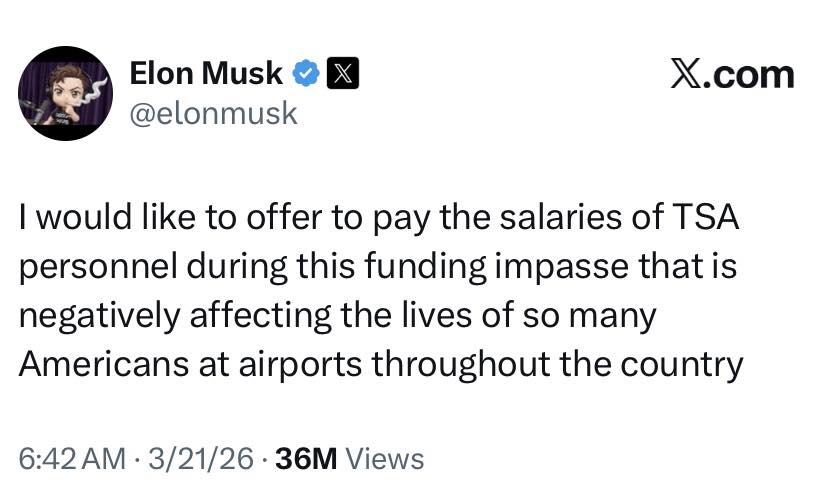
In a moment that perfectly captures the intersection of politics, business, and public frustration, Elon Musk has sparked global attention by offering to personally fund the salaries of U.S. airport security agents during a government funding crisis. The proposal, posted on his social media platform X, quickly went viral, but it raises a deeper question: is this a genuine solution to a national problem, or a calculated move in a larger influence game?
A Crisis That Opened the Door
The backdrop to Musk’s statement is a familiar but disruptive issue in the United States: a government shutdown. When Congress fails to pass funding legislation, federal agencies face partial closures, and hundreds of thousands of workers are affected.
Among the hardest hit are Transportation Security Administration (TSA) agents, the people responsible for airport security. Despite being classified as “essential workers,” many are required to continue working without pay during these shutdowns. This creates a dangerous imbalance: critical infrastructure depends on employees who are financially strained and increasingly demoralized.
This is the exact vulnerability Musk stepped into.
Musk’s Offer: Simple, Powerful, Unrealistic?
Musk’s proposal was straightforward: he is willing to cover TSA salaries until the political deadlock is resolved. On the surface, it sounds like a decisive and generous act, a billionaire stepping in where government fails.
But the reality is far more complicated.
For one, paying federal employees is not something a private individual can simply execute. Government payroll systems, legal frameworks, and accountability structures make such a move nearly impossible without congressional approval. Even if Musk were serious, and capable, the logistics alone would be overwhelming.
So why make the offer?
source: @elonmusk
The Real Strategy Behind the Statement
To understand this move, you have to look beyond the headline.
Musk is not just a businessman, he’s a master of narrative control. Whether through Tesla, SpaceX, or X, he consistently inserts himself into major global conversations. This offer positions him as:
- A problem solver in contrast to ineffective politicians;
- A champion of workers during crisis;
- A disruptive force willing to challenge traditional systems.
It’s not about whether he can pay TSA workers. It’s about showing that someone could and that the current system is failing.
That message resonates.
Public Reaction: Divided but Engaged
The internet reacted exactly as you’d expect, with a mix of admiration, skepticism, and criticism.
Supporters praised Musk for stepping up where politicians haven’t, arguing that his willingness to act highlights the inefficiency of government bureaucracy. Critics, however, dismissed the offer as performative a headline-grabbing tactic with no real intention of follow-through.
And both sides have a point.
The brilliance of the move is that it doesn’t require execution to be effective. The conversation itself is the win.
The Bigger Issue: Privatizing Public Responsibility
This situation also raises a deeper and more uncomfortable question: should essential public services ever depend on private individuals?
If a billionaire can step in and fund government operations, what does that say about the stability of public institutions?
There’s a fine line between innovation and erosion. While private sector efficiency can be appealing, relying on individuals, no matter how wealthy, introduces risks:
- Lack of accountability;
- Unequal influence over public systems;
- Precedents that weaken democratic structures.
Musk’s offer, whether intentional or not, touches on this tension.
Why This Story Matters for the Future
This isn’t just about TSA workers or one government shutdown. It’s about a shifting dynamic in global power.
Figures like Elon Musk are no longer just business leaders, they are political actors, cultural influencers, and, increasingly, perceived problem-solvers in times of crisis.
That changes how people view authority.
When trust in government drops, and private figures step in with bold ideas, even symbolic ones, public perception begins to shift. People start asking:
- Why can’t governments act this fast?
- Why do solutions come from outside the system?
- Who is really in control?
These questions matter more than the offer itself.
The Bottom Line
Elon Musk did not solve the TSA funding crisis. He didn’t need to.
What he did was far more strategic: he exposed a weakness, dominated the narrative, and positioned himself at the center of a global conversation.
That’s influence.
Also read: Donald Trump’s reaction to Robert Mueller’s death sparks controversy.