
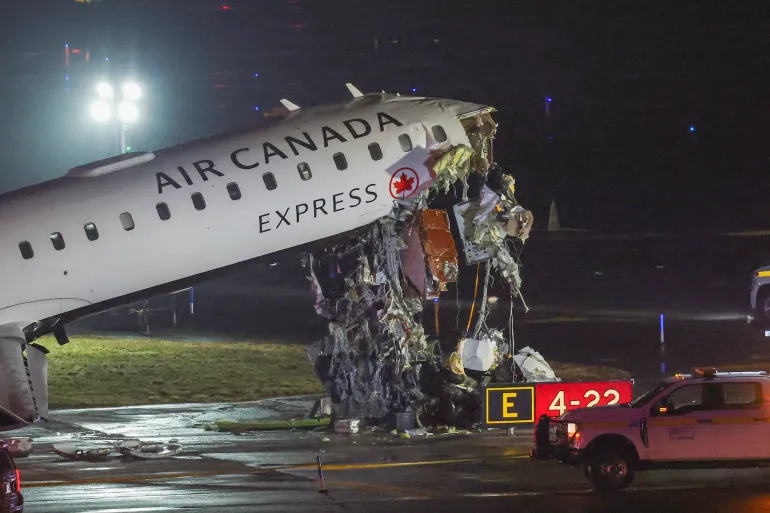
Timeline of the LaGuardia Runway Disaster
The incident occurred on March 23, 2026, at LaGuardia Airport, one of the busiest airports in the United States.
According to preliminary reports:
- Shortly before landing, an Air Canada Express regional jet approaching from Montreal was cleared for final descent;
- At the same time, a fire truck had been deployed onto the runway to respond to a separate aircraft-related emergency;
- Moments before touchdown, both the aircraft and the emergency vehicle were on the same active runway;
- The aircraft collided with the fire truck during landing, resulting in a high-impact crash.
Emergency response teams were already present due to the earlier incident, allowing for rapid medical intervention in the immediate aftermath.
Planes don’t just land into fire trucks. Not in 2026. Not at one of the busiest airports in the United States. The official investigation has just begun. But already, the outlines of a deeper problem are starting to show.
The Moment Everything Broke
According to early reporting from Reuters, the aircraft, an Air Canada Express regional jet arriving from Montreal was cleared to land as emergency crews were responding to a separate incident on the ground.
That alone is not unusual. Airports handle overlapping situations constantly. The system is built for it.
What is unusual and potentially catastrophic:
- A fire truck entered or remained on an active runway;
- The incoming aircraft continued its landing approach;
- Both ended up in the same place, at the same time.
That’s not supposed to be possible.
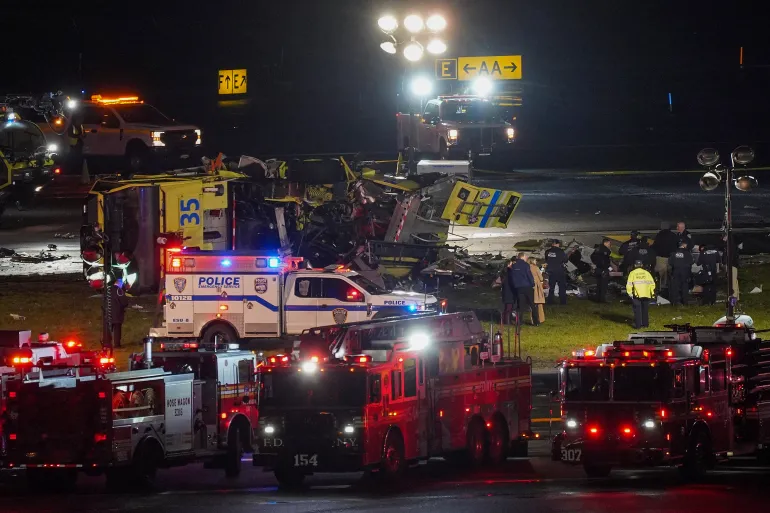
source: aljazeera.com
The Human Cost
The numbers are still stabilizing, but the confirmed damage is already severe:
- Both pilots were killed on impact;
- More than 40 people injured, including passengers and emergency personnel;
- Several victims remain hospitalized in serious condition.
There’s a brutal reality here that headlines don’t capture: pilots are trained for almost everything engine failure, weather, even partial system collapse.
What they are not trained for is a vehicle suddenly occupying their runway seconds before touchdown. At that point, there is no recovery.
A Chain of Failures – Not One Mistake
Early clues point to something aviation experts fear most: layered failure. Not one error. Several.
1. Runway Clearance Breakdown
Air traffic control is designed to prevent exactly this scenario. Every movement, aircraft or vehicle, requires explicit clearance.
If both the plane and the fire truck were cleared, that suggests:
- Miscommunication
- Overlapping instructions
- Or a breakdown in sequencing
2. Emergency Response Overlap
The fire truck was reportedly responding to a separate issue involving another aircraft. That complicates things:
- Controllers were juggling multiple priorities;
- Ground crews were under time pressure;
- Decisions may have been rushed.
3. Timing – The Critical Seconds
In aviation, timing isn’t measured in minutes. It’s measured in seconds. Once a plane is committed to landing:
- Speed is high;
- Visibility may be limited;
- Aborting is not always possible.
If the runway wasn’t clear at that exact moment, the outcome was already locked in.
Why This Should Worry You (Even If You Never Fly LaGuardia)
This isn’t just a local accident. It’s a system stress signal. Modern aviation is built on redundancy:
- Multiple checks;
- Multiple confirmations;
- Multiple layers of safety.
When a crash like this happens, it usually means those layers didn’t just fail – they failed together. That’s rare. And it’s dangerous.
The Bigger Question: Is the System Under Strain?
There’s an uncomfortable conversation happening quietly inside aviation circles right now. Not publicly. Not officially. But it’s there.
Staffing Pressure
Air traffic control in the U.S. has faced:
- Staffing shortages;
- Increased traffic volumes;
- Fatigue-related concerns.
When controllers are stretched thin, the margin for error shrinks.
Traffic Density
Air travel demand has surged again in recent years. Airports like LaGuardia operate with:
- Tight runway spacing;
- Constant arrivals and departures;
- Minimal room for delay.
That efficiency comes at a cost: less buffer when something unexpected happens.
Emergency Complexity
Handling one emergency is manageable. Handling one emergency while maintaining normal operations is where systems get tested. This crash suggests the system may have been pushed just beyond its safe limit.
What Investigators Will Look For Next
The investigation, led by the National Transportation Safety Board and the Federal Aviation Administration, will focus on three key areas:
1. Air Traffic Control Audio
Who said what and when? This will determine whether:
- Conflicting instructions were issued;
- Or instructions were misunderstood.
2. Cockpit Data (Black Box)
The aircraft’s flight data recorder will reveal:
- Speed and descent rate;
- Pilot reactions in final seconds;
- Whether a go-around was attempted.
3. Ground Vehicle Movement Logs
Every authorized vehicle on a runway is tracked. Investigators will ask:
- Why was the fire truck there?
- Who cleared it?
- Was it supposed to be there at that moment?
A Pattern or a One-Off?
Runway collisions are extremely rare but not unheard of. What makes this case different is where it happened:
- A major U.S. airport;
- Advanced traffic control systems;
- Highly trained personnel.
The Silence That Matters
Right now, officials are being careful. Statements are controlled. Details are limited. That’s normal. But what’s more telling is what hasn’t been said yet:
- No clear explanation for runway overlap;
- No confirmation of who had priority;
- No timeline of the final 60 seconds.
That gap is where the real story is. And it’s the part that will take weeks, or months to fully emerge.
Bottom Line
Two pilots are dead because a runway, one of the most controlled environments in modern transportation was not clear when it needed to be.
That should not happen. And when it does, it’s rarely just bad luck. It’s a signal.