
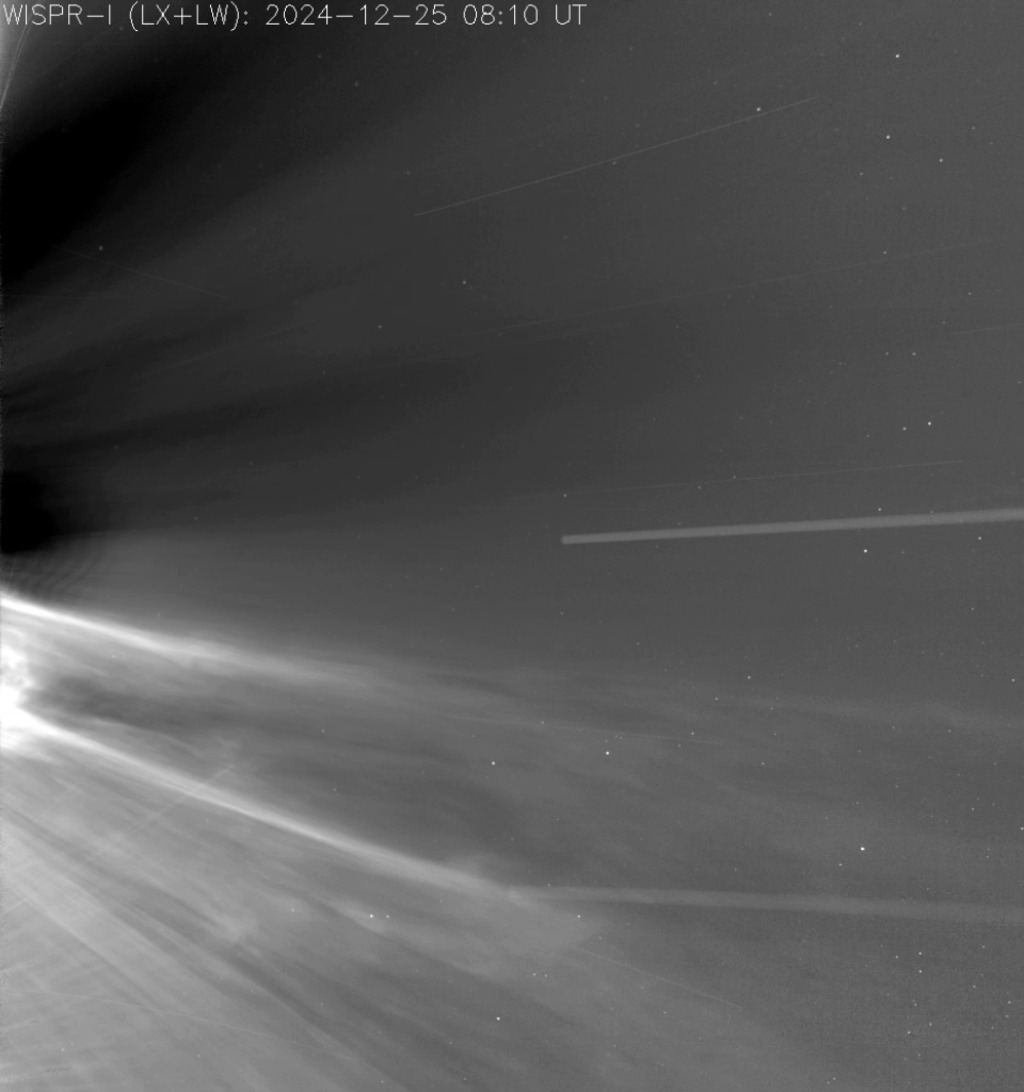
In July 2025, NASA revealed the closest-ever images of the Sun ever captured, stunning visuals taken from inside the star’s outer atmosphere, the corona, by the Parker Solar Probe. These historic images are not just beautiful snapshots; they are scientific breakthroughs that deepen our understanding of the Sun’s structure, dangerous solar storms, and how the Sun’s activity affects life on Earth and in space (NASA).
This article explains how these photos were taken, what they reveal, why they matter for space weather and technology, and what we can expect next.
What Is the Parker Solar Probe and Why It Matters
The Parker Solar Probe is a NASA mission launched in August 2018 with one of the boldest goals in space exploration: to travel closer to the Sun than any spacecraft before and capture data from within the star’s hostile outer atmosphere.
Rather than orbiting from afar like most solar observatories, the probe uses repeated Venus flybys to gradually tighten its orbit, bringing it closer to the Sun’s corona, the hot, tenuous outer layer where the solar wind originates. On its closest approach on December 24, 2024, the probe came within roughly 3.8 million miles (6.1 million km) of the solar surface (NASA).
This proximity allows instruments to study the Sun’s dynamic atmosphere, where temperatures soar and the seeds of space weather are born.
How the Closest Images Were Taken
One of the key instruments on board is WISPR (Wide-Field Imager for Solar Probe), designed to image the Sun’s corona and solar wind. Unlike traditional telescopes, WISPR captures light scattered by particles in the Sun’s outer atmosphere, revealing detailed structures of plasma, magnetic filaments, and mass ejections.
Because Parker Solar Probe flies so close, it must protect its instruments with an advanced heat shield capable of withstanding temperatures of nearly 2,500°F (1,370°C) while still allowing narrow windows for imaging (NASA Press Kit PDF).
During its perihelion pass, WISPR captured images showing the corona in unprecedented detail, including swirling plasma structures and the beginnings of the solar wind. NASA said these images offer scientists a view “where space weather threats to Earth begin, with our eyes, not just with models”.
What the Images Reveal – Beyond Beauty
The images provide important insights into phenomena that have puzzled scientists for decades:
Solar Wind Origins: For years, scientists have known that the Sun emits a constant stream of charged particles, the solar wind, but exactly how it accelerates was unclear. The close-up images show these particles shortly after they leave the corona, helping researchers trace their path and origin.
Corona Structure: The corona is hotter than the Sun’s surface, an enduring mystery. The high-resolution images reveal intricate magnetic loops and plumes that could explain why the corona reaches such extreme temperatures.
Space Weather and Solar Storms: Some images show magnetic structures that shape solar storms and coronal mass ejections (CMEs), massive releases of solar material that can disrupt satellite communications, GPS systems, and power grids on Earth.
Credit: NASA / Johns Hopkins APL / Naval Research Lab
Why This Breakthrough Matters for Earth
Solar activity is not distant; it directly affects our technology and infrastructure:
- Satellites can be damaged or knocked out;
- GPS and radio communications can become unreliable;
- Astronaut safety on orbiting platforms is at risk;
- Power grids on Earth can experience surges.
Close-up images help improve space weather forecasts, giving more accurate warnings about solar storms before they impact Earth (Phys.org).
What Scientists Are Learning
The data and images from Parker Solar Probe are reshaping long-standing solar science concepts:
- Magnetic Field Behavior: Solar magnetic fields twist and snap, releasing energy that drives flares and storms. Close-up images help researchers see this in action.
- Why the Corona Is Hot: The images provide evidence for mechanisms such as magnetic waves and particle acceleration that heat the corona.
- Solar Wind Dynamics: Understanding how solar wind forms and accelerates allows scientists to map interactions with planetary environments.
Future Prospects
Parker Solar Probe will continue its mission with additional close approaches, providing even more detailed images and insights. Complementary missions like the Solar Orbiter offer views of the Sun’s poles, helping create a full 3D understanding of solar dynamics.
Together, these missions are revolutionizing how we study the Sun.
A New Era of Solar Exploration
The release of the closest-ever images of the Sun marks a milestone in human understanding. These images from Parker Solar Probe offer unprecedented detail of the corona, solar wind, and magnetic fields, insights critical for protecting technology on Earth and understanding the dynamics of our star.
With each new pass, humanity sees the Sun not just as a distant glowing disk, but as a dynamic, complex, and powerful star influencing our entire solar system.
Continue Reading:
Politicians Talk About Global Warming While Science Warns the Next Ice Age Is Coming
Meet MangroveGS, the AI Tool that Predicts Cancer with accuracy

Ethan Brooks is a journalist with over 11 years of experience, specializing in finance, politics, and breaking news. He delivers timely, accurate reporting on market trends, economic developments, and major political events, helping readers stay informed on the stories that matter most.