Venezuela sits on top of more oil than any nation on Earth. According to the U.S. Energy Information Administration (EIA), the country holds an estimated 303 billion barrels of proven crude oil reserves, roughly a fifth of all the world’s supply. And yet, for decades, Venezuelan oil production went from nearly 3.5 million barrels per day in the late 1990s to struggling to breach 1 million. What followed is a story of political hubris, institutional collapse, escalating sanctions, and most recently a U.S. military operation that upended a century of international norms around oil sovereignty.
The Foundation: Oil, Nationalization, and a Company Called PDVSA
Venezuela’s oil story begins not in Caracas but in the village of La Rosa, where on December 14, 1922, a gusher roared 200 feet into the air from an oil well drilled by Royal Dutch Shell. That blowout was one of the most productive oil well discoveries on the planet and set Venezuela on a century-long course of stunning wealth, significant crashes, and political turmoil.
For decades, American and European multinationals, including Standard Oil, Shell, Gulf Oil, and Exxon, dominated Venezuelan petroleum production, operating under concession agreements that shared royalties with the government but kept operational control firmly in foreign hands.
That arrangement ended formally on January 1, 1976. Under President Carlos Andrés Pérez, Venezuela nationalized its oil industry, creating Petróleos de Venezuela, S.A. PDVSA to oversee all exploration, production, refining, and exporting of oil. According to the Council on Foreign Relations, Pérez structured PDVSA to run as a business with minimal government regulation, and foreign companies were compensated and invited to remain as technical and service partners.
According to Caracas Chronicles, the transition was smooth and cooperative, a far cry from how it would later be characterized. A New York Times report from the period noted that about 20 foreign oil companies received roughly $1 billion in compensation from Venezuela, and some negotiated contracts to continue providing marketing and technical expertise to PDVSA. No major diplomatic incident followed.
In its early years, PDVSA was among the most respected state oil companies in the world. During the 1970s oil boom, when an OPEC embargo quadrupled global prices, Venezuela briefly became the country with the highest per-capita income in Latin America, according to the Council on Foreign Relations. But the same source notes that analysts estimate as much as $100 billion was embezzled between 1972 and 1997, and the economy grew dangerously dependent on a single commodity. When oil prices crashed in the 1980s, so did Venezuela.
The Chávez Revolution: Oil as Political Weapon
Hugo Chávez won the presidency in 1998 promising to redirect oil wealth to the poor through his “Bolivarian Revolution.” Initially, social programs funded by PDVSA revenues reduced poverty and expanded access to education and healthcare. But Chávez’s relationship with PDVSA was inherently destabilizing.
The breaking point came in 2002–2003, when PDVSA employees launched a general strike to pressure Chávez to resign. According to the EIA, Chávez fired over 19,000 workers, gutting the company of engineers, geologists, and technical experts whose knowledge could not easily be replaced. Those workers took their expertise abroad, many moving to Alberta, Canada, where Venezuelan oil engineers could apply their skills on similarly heavy crude. Venezuelan crude oil production never fully recovered to pre-2002 levels, the EIA notes.
In 2006 and 2007, Chávez deepened nationalization by requiring all foreign oil companies to restructure their joint ventures to give PDVSA a minimum 60 percent ownership stake. Chevron, ENI, Repsol, Total, and Statoil agreed to the new terms and stayed. ExxonMobil and ConocoPhillips refused and withdrew, having their assets expropriated. Venezuela’s constitution declared all mineral and hydrocarbon deposits the sovereign property of the state, Samantha Gross of the Brookings Institution said: “the oil itself was never our oil.” The in-ground reserves always belonged to Venezuela.
But the expropriation of operational assets, pipelines, rigs, platforms, was a different matter. International tribunals later ruled that Venezuela owed ConocoPhillips $8.7 billion and ExxonMobil $1.6 billion in compensation for the 2007 seizures, according to CBS News. As of early 2026, neither company had been paid in full.
The Maduro Collapse: From Decline to Catastrophe
When Nicolás Maduro took power in 2013 after Chávez’s death, Venezuela was still exporting more than 800,000 barrels per day to the United States alone, according to Columbia University’s Center on Global Energy Policy. Oil revenues financed nearly 90 percent of state income.
Then, in mid-2014, global oil prices collapsed. Venezuela had no fiscal buffer. Maduro’s government responded by printing money, triggering hyperinflation that obliterated salaries and savings. The resulting humanitarian crisis drove nearly 8 million Venezuelans to leave the country, one of the largest displacement crises in the Western Hemisphere.
PDVSA, starved of investment and drained of talent, deteriorated rapidly. According to GIS Reports, production fell to an estimated 960,000 barrels per day in 2024, placing Venezuela 21st among global producers despite possessing the world’s largest reserves, a collapse described by GIS Reports as “historically unprecedented in Venezuela’s oil history.“
Energy analyst Carole Nakhle, CEO of Crystol Energy, told Al Jazeera that the collapse had roots far older than sanctions. “Chronic mismanagement, politicisation and underinvestment weakened the industry long before restrictions were imposed” she said. “Sanctions then accelerated and deepened the decline by restricting finance, operations and market access.“
The Sanctions Escalation and the Dark Fleet
The United States began imposing targeted sanctions on Venezuelan officials as early as 2005 under President George W. Bush. In March 2015, President Obama signed Executive Order 13692, expanding them in response to human rights abuses and corruption. In August 2017, the Trump administration restricted trading of Venezuelan bonds on U.S. markets. Then, in January 2019, sweeping sanctions on PDVSA itself halted U.S. crude imports from Venezuela almost entirely.
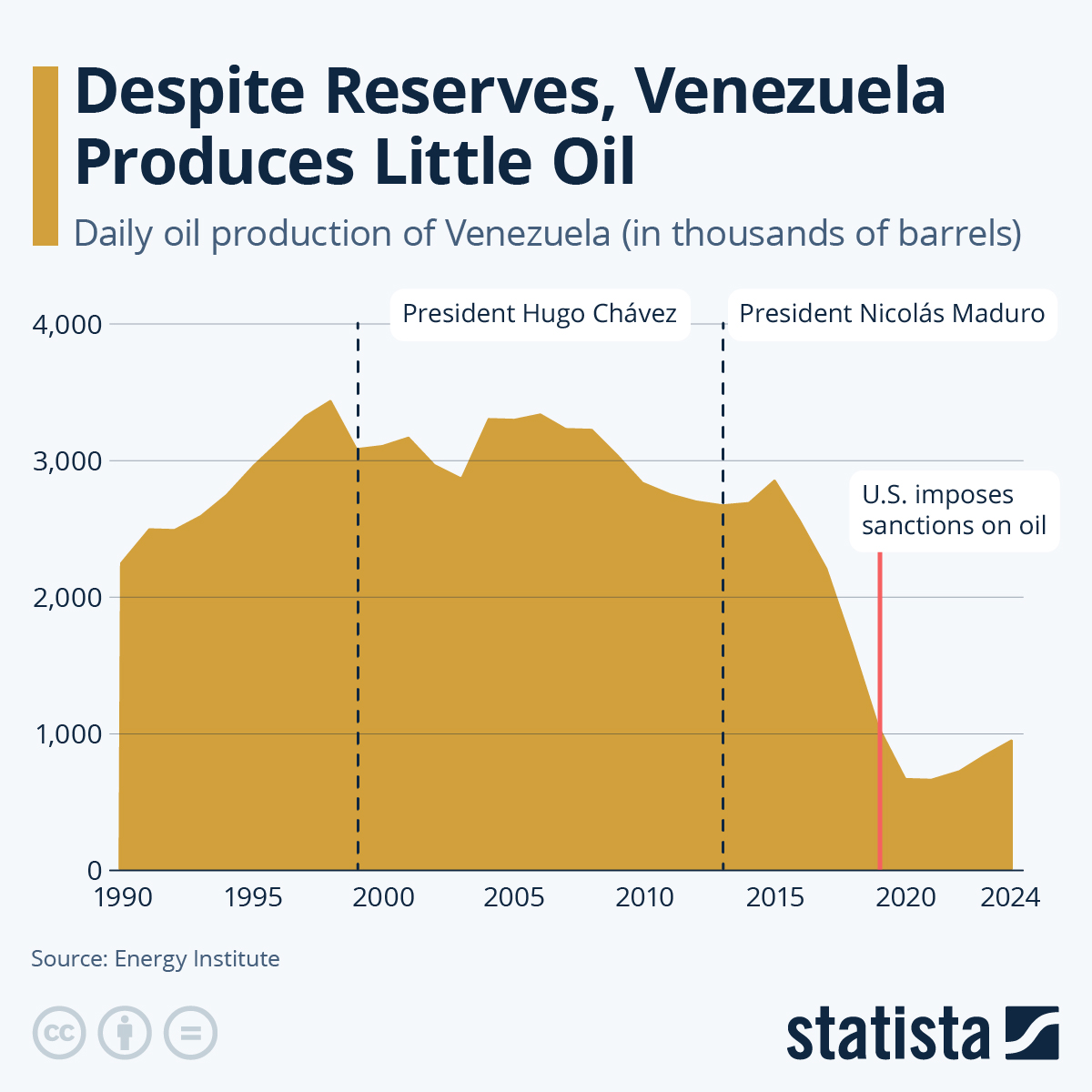 You will find more infographics at Statista
Cut off from Western markets, PDVSA pivoted to China and Russia. According to GIS Reports, by 2025 China received nearly 64 percent of Venezuelan oil exports, while the U.S. share had collapsed to just 4 percent, compared to 41 percent for the U.S. and 25 percent for China in 2017. Russia, through Rosneft and affiliated entities, supplied light crude needed to dilute Venezuela’s ultra-heavy Orinoco belt oil, circumventing sanctions through a network of tankers operating in “dark mode“, transponders switched off, flags falsified, ownership obscured.
The Biden administration offered a brief reprieve. In November 2022, the Treasury’s OFAC granted Chevron a special waiver to resume oil exports from its Venezuelan joint ventures. Following the 2023 Barbados Agreements, in which Maduro committed to holding elections with democratic guarantees, OFAC temporarily lifted most energy sanctions.
Production climbed from around 700,000 b/d to nearly 1 million b/d. But when Venezuela’s Supreme Court banned opposition candidate María Corina Machado, and Maduro then claimed victory in a July 2024 election that international monitors concluded he lost, the broader license was revoked and not renewed.
Trump’s Second Term: Blockade, Capture, and Oil Seizure
Donald Trump returned to the presidency in January 2025 with maximum pressure as his opening position on Venezuela. In March 2025, OFAC amended Chevron’s existing license to authorize only a 45-day wind-down of its operations, effectively reimposing the sanctions that Biden had loosened. Through late 2025, the administration sanctioned additional tankers and entities. According to SOUTHCOM, the U.S. military’s December 10, 2025 campaign of tanker apprehensions was the formal beginning of a naval blockade of Venezuelan oil.
The blockade was devastating. According to the Real Instituto Elcano, Venezuelan production, which had held near 1 million b/d for much of 2025, fell to around 800,000 b/d by December 2025 as storage filled and no oil could leave. About a dozen tankers loaded with crude oil slipped out of Venezuela in dark mode, hoping to run the blockade. Tracking service TankerTrackers.com confirmed that at least four later turned back when it became clear the blockade was real.
Then came January 3, 2026. In a pre-dawn military operation, U.S. special forces struck sites across Caracas and captured Nicolás Maduro and his wife Cilia Flores. They were flown to New York and pleaded not guilty in federal court. Trump declared that the United States would “run the country” until a “proper and judicious transition” took place. The stated justification was drug trafficking and narco-terrorism charges. The subtext, oil, was barely hidden.
What Trump Did With the Oil
Within days of the operation, the scope of what the Trump administration intended became clear. Trump announced that Venezuela would “turn over” between 30 and 50 million barrels of “high quality, sanctioned oil” to the United States, to be sold at market prices with proceeds controlled by the U.S. government.
On January 7, the U.S. seized two sanctioned tankers, one Russian-flagged, one in Caribbean waters, and the Coast Guard escorted them under American control. By January 21, according to Al Jazeera, the U.S. had seized a seventh Venezuela-linked tanker, the Motor Vessel Sagitta, in the Caribbean.
SOUTHCOM stated: “The apprehension of another tanker operating in defiance of President Trump’s established quarantine of sanctioned vessels demonstrates our resolve to ensure that the only oil leaving Venezuela will be oil that is coordinated properly and lawfully.” By February 25, the Pentagon reported seizing a third tanker in the Indian Ocean, the Bertha, which was found to be carrying 1.9 million barrels of Merey 16 crude, a grade of Venezuelan oil.
The financial architecture behind the seizures was unconventional. On January 9, Trump convened a White House meeting of oil executives, including the CEOs of Chevron, ExxonMobil, and ConocoPhillips, along with Treasury Secretary Scott Bessent, Interior Secretary Doug Burgum, and Energy Secretary Chris Wright. The discussion focused on what it would take for U.S. companies to re-enter Venezuela.
On January 14, the Trump administration confirmed its first Venezuelan oil sale, valued at $500 million, as part of what was described as a $2 billion deal. The buyer was Vitol, a Geneva-based energy and commodity trading firm whose U.S. arm is headquartered in Houston and which had previously donated millions to Trump’s 2024 campaign, according to Truthout. The proceeds from oil sales were being held in bank accounts controlled by the U.S. government, with the main account located in Qatar, described by a senior administration official as a neutral location where money can flow freely without risk of seizure.
The Qatar arrangement drew immediate criticism. Senator Elizabeth Warren told Semafor: “There is no basis in law for a president to set up an offshore account that he controls so that he can sell assets seized by the American military. That is precisely a move that a corrupt politician would be attracted to.” Senator Cory Booker called it “yet another example of his unchecked corruption“.
Treasury Secretary Scott Bessent said at the Economic Club of Minnesota that his department “will oversee the accounts” and that disbursements back to Venezuela would occur “at the president’s direction” and that of Secretary of State Marco Rubio. Venezuela’s interim president Delcy Rodríguez, Maduro’s former vice president, now installed as the country’s leader, confirmed receiving a first payment of $300 million and said the money would go to Venezuelan banks and the central bank.
By his State of the Union address in late February 2026, Trump declared that the United States had received “more than 80 million barrels of oil” from Venezuela. “We’re selling it on the open market” he told Congress. “We’re bringing down oil prices incredibly.“
The “Stolen Oil” Claim
Trump framed the entire operation around a claim of retribution. “We built Venezuela’s oil industry with American talent, drive and skill, and the socialist regime stole it from us” he said at a January 3 press conference. The following day, aboard Air Force One, Trump said: “It was the greatest theft in the history of America.“
Legal scholars and energy experts pushed back decisively. Roxanna Vigil, an international affairs fellow at the Council on Foreign Relations, told FactCheck.org that the expropriated assets belonged to private companies, not the U.S. government, and that the in-ground oil “always belonged to Venezuela.“
Big Oil’s Actual Response: Caution Over Excitement
Trump’s vision of U.S. oil majors flooding into Venezuela was not immediately shared by the companies themselves. At the January 9 White House meeting, ExxonMobil CEO Darren Woods said Venezuela was “uninvestable” in its current state. Trump responded by threatening to sideline Exxon from future Venezuelan opportunities. “I didn’t like Exxon’s response. You know we have so many that want it. I’d probably be inclined to keep Exxon out” Trump told reporters.
According to CNN, industry sources said American oil executives were unlikely to commit large capital to Venezuela for several reasons: the political situation remained deeply uncertain, the oil infrastructure was in ruins after decades of neglect, and the country had a documented history of seizing foreign assets without full compensation.
According to the Bipartisan Policy Center, restoring Venezuelan production to pre-Maduro levels near 2.5 million b/d would require an estimated $80 to $90 billion in investment over six to seven years.
Chevron, the only major U.S. oil company still operating in Venezuela, was more optimistic. According to Semafor, a Trump administration official said Chevron believed it could expand its Venezuelan production by 50 percent within two years.
The Geopolitical Fallout
The January 3 operation triggered alarm across Latin America and Europe. Russia, whose companies had joint ventures accounting for more than 20 percent of Venezuelan production by mid-2024, according to the Real Instituto Elcano, pleaded with the U.S. to ensure the safe return of its citizens found aboard a seized Russian-flagged tanker. China, which received nearly two-thirds of Venezuelan oil exports in 2025, faced the prospect of being systematically cut out of those flows.
According to Global Witness, oil sanctions and the naval blockade remained in place even after Maduro’s capture, and Trump floated the idea of taking charge of PDVSA directly. The White House issued a fact sheet stating that safeguarding Venezuelan oil revenues was essential to “preventing seizure of Venezuelan oil revenue that could undermine critical U.S. efforts to ensure economic and political stability in Venezuela” while also “countering malign foreign influence” from Iran and Hezbollah.
Legal experts widely disputed the U.S.’s right to seize and sell another nation’s oil, with Al Jazeera noting that “the legality of using military force to enforce economic penalties is disputed.“
Conclusion: A Century of Oil, A Nation’s Reckoning
The story of Venezuelan oil is a century-long paradox, a country so rich in resources that the wealth itself became the mechanism of its dysfunction. According to the Council on Foreign Relations, over $100 billion was embezzled before Chávez even took office. Then a combined total of a trillion dollars in oil revenue was mismanaged, redirected, or stolen across the Chávez and Maduro eras, driving 8 million people from their homes and collapsing one of Latin America’s once-great economies.
Sanctions accelerated a decline that was already structural. As energy analyst Carole Nakhle put it to Al Jazeera: the collapse “predates sanctions.” But maximum pressure made recovery virtually impossible, and the seizure of physical oil cargoes, an act without modern precedent between nominally non-warring states, has fundamentally altered what recovery might even look like.
As of early 2026, Trump claims the U.S. has received more than 80 million barrels of Venezuelan oil. The first $500 million sale went through Vitol, with proceeds parked in Qatar. A U.S.-controlled bank account, a foreign nation’s oil, a regime change with unclear legal grounding and an industry so broken that even the American companies invited to profit from it are reluctant to move in.
Venezuela’s oil, the most abundant in the world, remains largely in the ground. Whether it ever flows again at meaningful scale will depend less on geology, which was never the problem, and more on whether the politics, governance, and investment conditions that destroyed the industry over five decades can be rebuilt.
Photo by Gage Skidmore, via Wikimedia Commons, licensed under CC BY-SA 3.0.
Continue Reading:
Asian Stock Markets Bleed Out After Trump’s Iran Speech
France to U.S.: NATO Exists for Euro‑Atlantic Security
How to Start an Emergency Fund in 2026 on a Tight Budget

Ethan Brooks is a journalist with over 11 years of experience, specializing in finance, politics, and breaking news. He delivers timely, accurate reporting on market trends, economic developments, and major political events, helping readers stay informed on the stories that matter most.