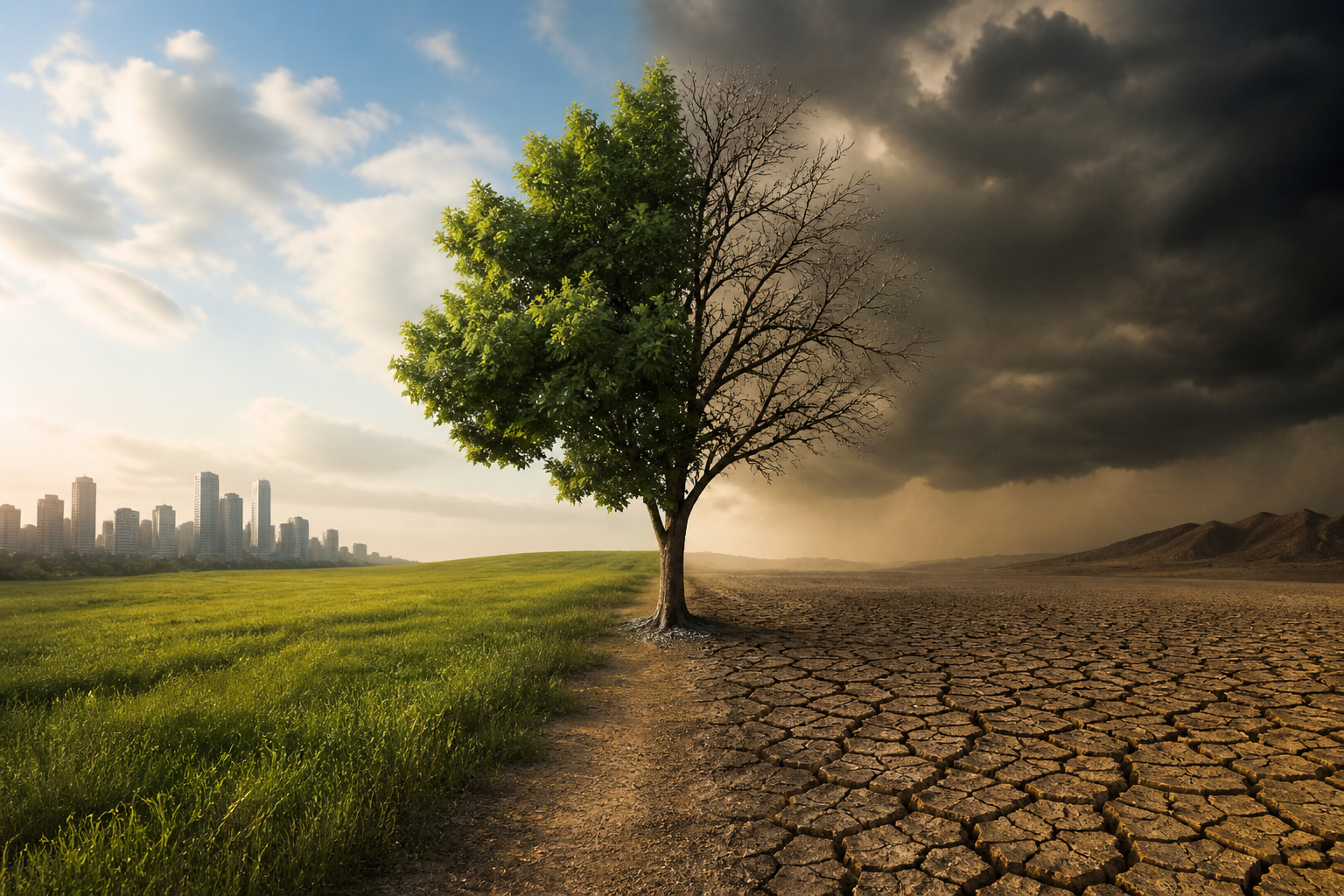
In everyday language, people often say “climate change” and “global warming” interchangeably. Technically, global warming refers to the long‑term rise in Earth’s average surface temperature, while climate change includes broader shifts: changes in rainfall, storms, sea level, and ecosystems.
The Intergovernmental Panel on Climate Change (IPCC) states that human activities have warmed the planet by about 1.1–1.2°C above pre‑industrial levels, and this change is accelerating. This small number may sound tiny, but that extra heat has major real‑world consequences for weather, oceans, and ice sheets.
The greenhouse effect: nature’s natural blanket
The physics of climate change hinges on the greenhouse effect, a natural process without which Earth would be far too cold to support life. According to the UK Government’s climate‑change page, certain gases in the atmosphere, carbon dioxide (CO₂), methane (CH₄), nitrous oxide (N₂O), and water vapour, trap heat radiating from the planet’s surface, keeping global temperatures within a habitable range.
Human activities have turned this natural blanket into an increasingly thick one. Burning fossil fuels, clearing forests, and industrializing agriculture have boosted the concentration of greenhouse gases far beyond the levels seen in at least the last 800,000 years, as recorded in ice‑core data.
The United Nations explains that fossil fuels alone account for roughly two‑thirds of global greenhouse‑gas emissions and nearly 90% of CO₂ emissions, which is why they are the main driver of modern climate change.
Main causes of climate change
1. Burning fossil fuels
The single largest driver of modern climate change is the combustion of coal, oil, and natural gas for electricity, transport, heating, and industry. According to the European Climate‑change portal, power plants, cars, ships, and airplanes release vast amounts of CO₂ and other pollutants into the atmosphere, where they accumulate for decades or centuries.
A study by the European Commission notes that burning coal, oil, and gas produces both CO₂ and nitrous oxide, gases that strongly enhance the greenhouse effect and push global temperatures higher. The IPCC finds that emissions from human‑caused greenhouse gases are responsible for essentially all of the warming observed since the late 1800s, making fossil‑fuel dependence central to the climate crisis.
2. Deforestation and land‑use change
Forests act as “carbon sinks,” absorbing CO₂ from the atmosphere and storing it in wood and soil. When trees are cut down or burned for agriculture, logging, or urban expansion, that stored carbon is released back into the air while the planet loses a key natural tool for cooling itself.
Deforestation and other land‑use changes contribute roughly a third of global greenhouse‑gas emissions, making them a major contributor to climate change. This loss of forests also reduces biodiversity and weakens the resilience of ecosystems to extreme weather, further amplifying climate impacts.
3. Agriculture and livestock
Farming is a growing source of emissions beyond just the burning of fossil fuels. Methane from ruminant animals (like cattle), nitrous oxide from synthetic fertilizers, and CO₂ from land‑clearing all add to the warming effect.
The NRDC explains that agriculture alone contributes a significant share of greenhouse‑gas emissions through energy‑intensive production, livestock numbers, and fertilizer use. These emissions are further amplified by the loss of grasslands and wetlands that otherwise store carbon, making food‑system emissions a critical part of the climate story.
4. Industrial processes and waste
Cement production, chemical manufacturing, metal refining, and other industrial processes release CO₂ and other gases through high‑temperature reactions and energy use. Waste decomposition in landfills also emits methane, especially in rapidly urbanizing regions without modern waste‑management systems.
Taken together, human‑driven causes, fossil fuels, deforestation, agriculture, and industry, have created what many scientific assessments call an “unequivocal” anthropogenic (human‑caused) climate trend.
Read More: Scientists Create “Tumor-Eating” Bacteria That Can Destroy Cancer From the Inside
Evidence that climate change is happening
Rising global temperatures
Instrumental records from weather stations, ships, and satellites show that Earth’s average surface temperature has increased by more than 1°C since the late 1800s, with the fastest warming occurring in recent decades.
Independent datasets maintained by NASA confirm this trend, showing that the warmest years on record have clustered in the 2010s and 2020s. The planet is absorbing far more energy than it is radiating to space.
Melting ice and rising seas
Satellites and field observations document dramatic declines in Arctic sea ice, glaciers, and ice sheets in Greenland and Antarctica. As these ice masses melt, they add water to the oceans, while warmer seawater itself expands, causing global sea levels to rise.
According to the European Commission’s climate portal, higher sea levels increase the risk of coastal flooding, storm‑surge damage, and permanent inundation of low‑lying areas, including major cities and small island states. Scientists warns that even a 1.5–2°C warming could submerge substantial parts of coastal regions and wetlands, threatening infrastructure and ecosystems.
More extreme weather
Climate change does not just raise average temperatures; it also alters the frequency and intensity of weather extremes. Heatwaves, droughts, heavy rainfall, floods, and intense storms have all become more common and more severe in many regions.
Warmer temperatures over time disrupt the usual balance of nature, leading to more frequent high‑temperature extremes and irregular rainfall patterns. Independent analyses by Greenpeace show that millions of people are already experiencing climate‑related disasters, from deadly heat in Europe to floods and landslides in Asia and Africa.
Read More: Brain Mapping with RNA Barcodes: Understanding the Brain’s Hidden Wiring
Major effects of climate change on people
1. Health risks from heat and pollution
Higher temperatures increase the incidence of heat‑related illnesses and deaths, especially among the elderly, children, and people with pre‑existing conditions. Urban “heat islands” where concrete and asphalt trap heat, worsen these risks in cities around the world.
According to the World Wildlife Fund, heat and changing weather patterns also affect air quality and the spread of infectious diseases, such as those carried by mosquitoes whose ranges expand in warmer climates. Climate‑related health impacts are expected to grow in severity if global warming continues unchecked.
2. Food and water insecurity
Climate change stresses water and food systems by altering rainfall patterns and intensifying droughts, floods, and wildfires. In many regions, farmers face shorter growing seasons, destroyed crops, or unreliable water supplies, which can drive up food prices and deepen hunger and malnutrition.
A 2026 report by S&P Global highlights that climate‑driven shifts in temperature and precipitation may also shift the geographic distribution of suitable farmland, forcing communities to adapt or migrate. Scientists warns that this pressure on water and food systems is one of the top climate‑related economic risks by 2050.
3. Economic costs and inequality
Climate‑related disasters damage infrastructure, disrupt supply chains, and drive up insurance and repair costs. A scientific‑consensus overview notes that unchecked warming could cost hundreds of billions or even trillions of dollars annually in lost output, property damage, and adaptation measures.
The United Nations reports that low‑income communities and developing countries are often hit hardest, despite contributing less to global emissions. Extreme weather events can wipe out savings, destroy homes, and force people to migrate, deepening global inequality.
4. Biodiversity and ecosystem collapse
Climate change is a major driver of biodiversity loss. As temperatures and rainfall patterns shift, species are forced to move, adapt, or face extinction. Coral reefs, forests, wetlands, and polar ecosystems are especially vulnerable, with large fractions of existing species at risk under high‑warming scenarios by 2100.
The loss of biodiversity weakens natural systems that provide food, clean water, and protection from storms, making societies even more exposed to climate shocks. Scientists stress that climate action and conservation must be combined to reduce this risk.
Read More: Why Scientists Believe Microplastics Could Become One of the Biggest Health Crises of the Century
What can we do? Practical solutions for climate change
Reducing greenhouse‑gas emissions is the core way to slow climate change. The IPCC and multiple scientific bodies agree that deep cuts in CO₂ and other emissions this decade are essential to keep global warming below 1.5–2°C and avoid the worst impacts.
Key strategies include:
- Scaling up renewable energy (solar, wind, and geothermal) and phasing out coal and other fossil‑fuel‑based power.
- Protecting and restoring forests and other natural carbon sinks.
- Improving energy efficiency in buildings, transport, and industry.
- Shifting diets and farming practices to reduce methane and nitrous oxide emissions.
For more science news and research coverage, visit the Science section at bdesk.news.

Michaela Reeds is an investigative journalist and reporter with a focus on politics, science, and technology. She brings clarity to complex issues, translating policy developments, scientific breakthroughs, and technological innovations into compelling stories for a broad audience. She is known for her dedication to accuracy, transparency, and in‑depth reporting.