Global tensions surged this week after U.S. President Donald Trump issued one of his most aggressive warnings yet during the ongoing conflict with Iran, threatening to devastate the country’s infrastructure and push it “back to the Stone Ages.” Only hours later, however, the White House announced a dramatic shift: a two-week pause in attacks to allow negotiations aimed at ending the war.
The sudden change has left allies, critics, and global markets trying to understand whether the move signals a real path to diplomacy, or simply a temporary pause in an increasingly dangerous confrontation.
Trump’s Threat: “Stone Ages” Warning
The controversy began when Trump issued stark warnings that the United States could unleash overwhelming military force if Iran did not meet U.S. demands related to the ongoing conflict and the strategic Strait of Hormuz, a critical global oil route.
According to reports from multiple outlets, such as Reuters, Trump said the U.S. could destroy Iran’s infrastructure, including bridges and power plants, in a matter of hours if Tehran failed to comply.
In earlier remarks about the war, he warned that Iran could be “bombed back to the Stone Ages,” language that quickly sparked international backlash and raised fears of escalation.
The threat came amid rising tensions after weeks of military exchanges between the U.S., Israel, and Iran. The war began in late February 2026 and has already caused significant casualties and damage across the region.
Trump’s rhetoric alarmed legal experts and world leaders, who warned that targeting civilian infrastructure could violate international law. Some critics argued the language suggested potential war crimes if such actions were carried out.
A Sudden Shift: Two Weeks for Negotiations
Despite the aggressive tone earlier in the day, Trump later announced that the United States would pause planned bombing operations for two weeks if Iran agreed to certain conditions.
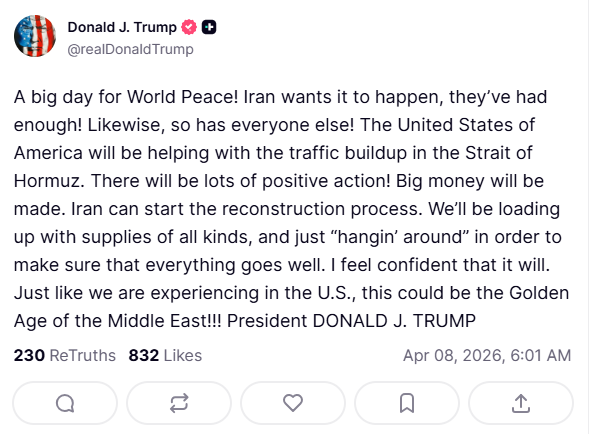
The proposal reportedly came after diplomatic pressure from several countries, including Pakistan, which helped mediate the talks.
Under the tentative arrangement:
- The U.S. would suspend major military strikes for 14 days.
- Iran would allow the reopening of the Strait of Hormuz, which carries about 20% of the world’s oil shipments.
- Both sides would begin negotiations based on a 10-point proposal presented by Iran.
Trump described the plan as a “workable basis” for further talks, though he warned that military action could resume if negotiations fail.
Global Reaction: Shock, Support, and Skepticism
The sharp shift from threats to diplomacy triggered mixed reactions worldwide.
Many international leaders welcomed the pause in fighting, seeing it as a chance to prevent a broader Middle East war. However, critics argued that Trump’s earlier statements were dangerously inflammatory and could escalate tensions rather than resolve them.
Some U.S. lawmakers and foreign policy experts also questioned whether the threats were part of a negotiation tactic or evidence of unpredictable leadership.
At the same time, Iran signaled it was willing to cooperate with the ceasefire proposal if U.S. attacks stopped and safe passage through the Strait of Hormuz was guaranteed.
Economic Impact: Markets React Immediately
The ceasefire announcement had an immediate effect on global markets.
Oil prices dropped sharply after investors believed the risk of a major Middle East escalation had temporarily decreased. Stock markets in Asia and Europe also surged following the news of the two-week pause.
Energy analysts say the Strait of Hormuz is a key factor in the crisis. If shipping through the waterway is disrupted, oil prices can spike dramatically worldwide.
The reopening of the strait, even temporarily, helped stabilize global energy markets.
What Happens Next?
The next two weeks could determine whether the conflict escalates further or moves toward a diplomatic solution.
Negotiations are expected to involve several international mediators, and early talks may focus on reopening shipping routes, halting missile strikes, and creating conditions for a broader peace agreement.
However, skepticism remains high. Analysts note that similar deadlines and warnings have appeared multiple times during the conflict, sometimes leading to escalation rather than resolution.
For now, the situation remains fragile. The ceasefire could either become the first step toward peace or simply a brief pause before the next stage of the war.
Continue Reading:
Trump’s 13‑Year‑Old Accuser Got “Censored” by the FBI – What Are They Hiding?
Trump Fires Attorney General Pam Bondi: The Loyalty That Was Never Enough
U.S. Insolvent? Treasury Financials Reveal Massive Liabilities Experts Say

Ethan Brooks is a journalist with over 11 years of experience, specializing in finance, politics, and breaking news. He delivers timely, accurate reporting on market trends, economic developments, and major political events, helping readers stay informed on the stories that matter most.