Tensions between Russia and the West have escalated sharply after Moscow issued a direct threat naming four specific locations in the United Kingdom as potential targets. The warning, widely reported across international media, marks a significant shift from general rhetoric to explicitly identified sites, raising concerns about security, geopolitics, and the risk of wider conflict.
A Chilling Warning from Moscow
Russia has publicly identified four UK locations, London, Leicester, Reading, and Mildenhall in Suffolk, as potential targets for military strikes. According to The Sun, these locations are allegedly linked to the production or support of military equipment, particularly drones used by Ukraine in its ongoing war with Russia.
The warning was not delivered quietly. Instead, it was amplified by high-profile Russian officials, including former president Dmitry Medvedev, who issued a blunt and provocative message suggesting Europeans should “sleep well” implying that potential strikes could happen depending on future developments.
This combination of specificity and public messaging has made the threat stand out compared to previous statements.
Why These Locations Were Named
According to Russian claims, reported by LBC, the targeted sites are connected to the supply chain supporting Ukraine’s military, particularly drone manufacturing and logistics. The Kremlin has accused Western countries, including the UK, of increasingly becoming direct participants in the conflict by providing weapons and infrastructure support.
For example:
- London – Allegedly linked to companies supplying industrial or military equipment;
- Leicester – Reportedly associated with drone-related manufacturing;
- Reading – Included as part of the broader supply network;
- Mildenhall (Suffolk) – Home to a major RAF and US Air Force presence, making it strategically significant.
These claims have not been independently verified, and the UK government has not confirmed any direct military production roles at the specific sites mentioned.
A Shift from Rhetoric to Targeting
What makes this development particularly concerning is the level of detail. Previous Russian warnings toward Western nations have often been broad or symbolic. This time, however, Moscow has effectively published a list of physical locations.
Analysts note that naming specific targets changes the psychological and political impact of such statements. It transforms a general geopolitical warning into something more tangible and immediate, potentially affecting public perception and national security planning.
The Context: War in Ukraine
This threat cannot be understood without looking at the broader context of the war in Ukraine.
Since Russia’s full-scale invasion began in 2022, Western countries, including the UK, have provided extensive military aid to Ukraine. Recently, the UK announced new support packages, including tens of thousands of drones intended to strengthen Ukraine’s battlefield capabilities.
From Russia’s perspective, such actions are seen as escalation. The Kremlin argues that supplying weapons and facilitating production effectively turns supporting nations into participants in the conflict.
This narrative has been used repeatedly by Russian officials to justify increasingly aggressive rhetoric toward NATO countries.
Part of a Wider European Warning
The UK is not alone in this situation. Russia’s list reportedly includes multiple locations across Europe, spanning countries such as Germany, Poland, the Netherlands, and others involved in supporting Ukraine.
This broader scope suggests the message is not solely aimed at Britain but at the entire Western alliance.
By identifying multiple countries, Russia appears to be signaling that any nation contributing to Ukraine’s war effort could be considered a legitimate target, at least rhetorically.
Hybrid Warfare and Previous Incidents
The threat also fits into a broader pattern of what experts describe as “hybrid warfare.” This includes not only military actions but also cyberattacks, sabotage, and psychological operations.
Recent investigations across Europe have linked Russia to covert operations, including parcel bomb plots and sabotage attempts targeting infrastructure. These incidents were believed to test vulnerabilities in logistics and supply chains supporting Ukraine.
While the current threat does not confirm any imminent attack, it aligns with a strategy aimed at intimidation and disruption.
How Serious Is the Threat?
It’s important to separate rhetoric from immediate risk.
At present, there is no confirmed evidence that an attack on UK soil is imminent. Military experts generally view such statements as part of strategic signaling rather than operational planning.
However, dismissing the threat entirely would be a mistake.
There are several reasons why:
- Escalation risk – The more direct the language, the higher the chance of miscalculation;
- Public impact – Naming cities can create fear and uncertainty;
- Security response – Governments must treat such threats seriously, even if they are unlikely.
The UK, as a NATO member, benefits from collective defense agreements, meaning any direct attack would have massive consequences for global security.
Political and Strategic Implications
These statements puts additional pressure on Western governments, especially regarding their support for Ukraine.
On one hand, backing Ukraine is seen as essential for European security and stability. On the other, direct threats like this highlight the risks of deeper involvement.
For the UK government, the challenge is balancing deterrence with de-escalation:
- Continue supporting Ukraine without appearing to provoke direct conflict;
- Strengthen domestic security without causing public panic;
- Coordinate closely with NATO allies to present a unified response.
What Happens Next?
The situation remains fluid. Several possible scenarios could unfold:
- Rhetorical escalation continues – More threats but no direct action;
- Increased cyber or covert attacks – A more likely short-term risk;
- Diplomatic tensions rise – Further deterioration in Russia-West relations;
- Military escalation (low probability, high impact) – A worst-case scenario.
Most analysts believe the first two outcomes are the most probable in the near term.
Final Thoughts
Russia’s decision to name specific UK locations as potential targets represents a notable escalation in tone and strategy. While there is no immediate evidence of an impending attack, the move underscores how volatile the geopolitical situation has become.
This is not just about four cities in the UK, it’s about the broader confrontation between Russia and the West, with Ukraine at its center.
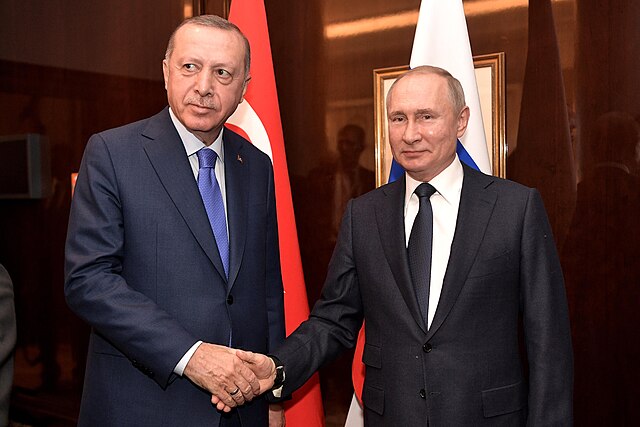
Photo:President of the Russian Federation, licensed under the Creative Commons Attribution 4.0
For more political reporting and in-depth analysis, visit the Politics section at bdesk.news.
Continue reading:
Trump Administration Cancels $11M Catholic Charities Contract
Pentagon Prepares for Military Operation in Cuba

Michaela Reeds is an investigative journalist and reporter with a focus on politics, science, and technology. She brings clarity to complex issues, translating policy developments, scientific breakthroughs, and technological innovations into compelling stories for a broad audience. She is known for her dedication to accuracy, transparency, and in‑depth reporting.