
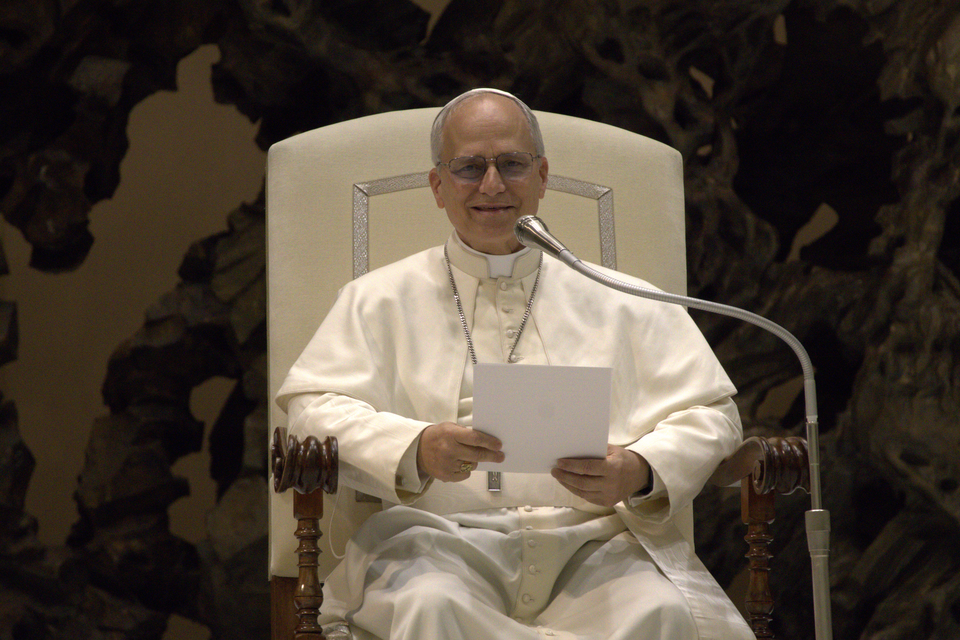
Pope Leo XIV issued a stark warning Thursday that unchecked investment in artificial intelligence and advanced weaponry is accelerating humanity toward catastrophic conflict. Speaking at Sapienza University of Rome, the pontiff called explicitly for an end to wars in Ukraine and the Middle East, framing these ongoing conflicts as symptomatic of broader technological and moral crises.
“The investments in artificial intelligence and high-tech weaponry are leading the world into a spiral of annihilation.” Pope Leo XIV, Sapienza University of Rome, May 14, 2026.
The statement, reported by NPR, represents the Vatican’s most direct critique to date of military AI development. The Pope’s remarks come amid accelerating global tensions and record military expenditures. According to international security assessments, global defense spending reached $2.4 trillion in 2025, with AI-based weapons systems commanding an increasingly large share of military research and procurement budgets across major powers.
The Pope’s language, specifically his invocation of a “spiral”, suggests not isolated incidents but rather an accelerating trajectory toward systemic collapse. The term carries theological weight within Catholic tradition, implying both inevitability and moral responsibility. The phrase suggests that without deliberate intervention, current technological and geopolitical dynamics will produce catastrophic outcomes.
The Vatican has engaged with AI policy intermittently but without establishing binding institutional mechanisms. Last year, Pope Leo XIV issued guidelines urging technology companies to incorporate ethical safeguards, though these lacked enforcement power. The present statement escalates the Vatican’s tone without offering concrete policy proposals or mechanisms for implementation.
Geopolitical Context
The timing coincides with sustained diplomatic efforts by the Trump administration in both Ukraine and the Middle East, which have yielded limited concrete progress. Both conflicts have demonstrated the capacity of modern military technology to inflict massive civilian casualties. Ukraine has suffered an estimated 600,000 casualties since 2022, while ongoing conflicts in the Middle East have displaced millions and generated significant humanitarian crises.
The Pope’s simultaneous mention of both regions suggests he views them as connected symptoms rather than isolated crises. Both involve prolonged wars where advanced weapons systems continue to be deployed, funded, and developed. The Vatican’s framing implies that resources devoted to weapons development represent a fundamental misallocation of human capital and financial resources.
Read More: Pope Calling for Peace as Global Tensions Rise: “Dialogue Must Replace Conflict”
Broader Technological Concerns
The Pope’s warnings align with concerns articulated by technology ethicists and some defense analysts. In January, a coalition of theologians, ethicists, and AI researchers published an open letter to world governments calling for an immediate moratorium on autonomous weapons development. The international Campaign to Stop Killer Robots has similarly sought restrictions on fully autonomous weapons systems, with mixed success.
However, religious appeals have historically exerted limited influence on military procurement decisions. Defense establishments in major powers view AI weaponization as strategically essential rather than morally optional. The structural incentives driving weapons development, institutional budgets, geopolitical competition, industrial interests, remain largely independent of moral or ethical arguments.
The Pope did not elaborate on potential solutions, whether international treaties, technological restrictions, or reallocation of defense budgets toward development and humanitarian goals. The Vatican spokesperson declined to confirm whether the remarks represent a shift in papal technology engagement strategy.
Forward Trajectory
Pope Leo XIV is scheduled to address the United Nations General Assembly next month, providing a potential platform to elaborate on technological and military governance concerns. Whether the Pope will use that forum to advance specific policy proposals or maintain his current focus on moral exhortation remains unclear.
The statement serves primarily to document Vatican concern rather than to catalyze policy change. Its significance lies in elevating questions of AI ethics and military spending within global discourse, lending institutional credibility to arguments that might otherwise remain confined to academic and activist circles. Whether that rhetorical elevation translates into meaningful policy shifts depends on actors beyond the Vatican’s direct control.
Image: Wikimedia Commons / Edgar Beltrán, The Pillar.
For more society news and cultural reporting, visit the Society section at bdesk.news.

Ethan R. Brooks is a journalist with over 11 years of experience, specializing in finance, politics, and breaking news. He delivers timely, accurate reporting on market trends, economic developments, and major political events, helping readers stay informed on the stories that matter most.