
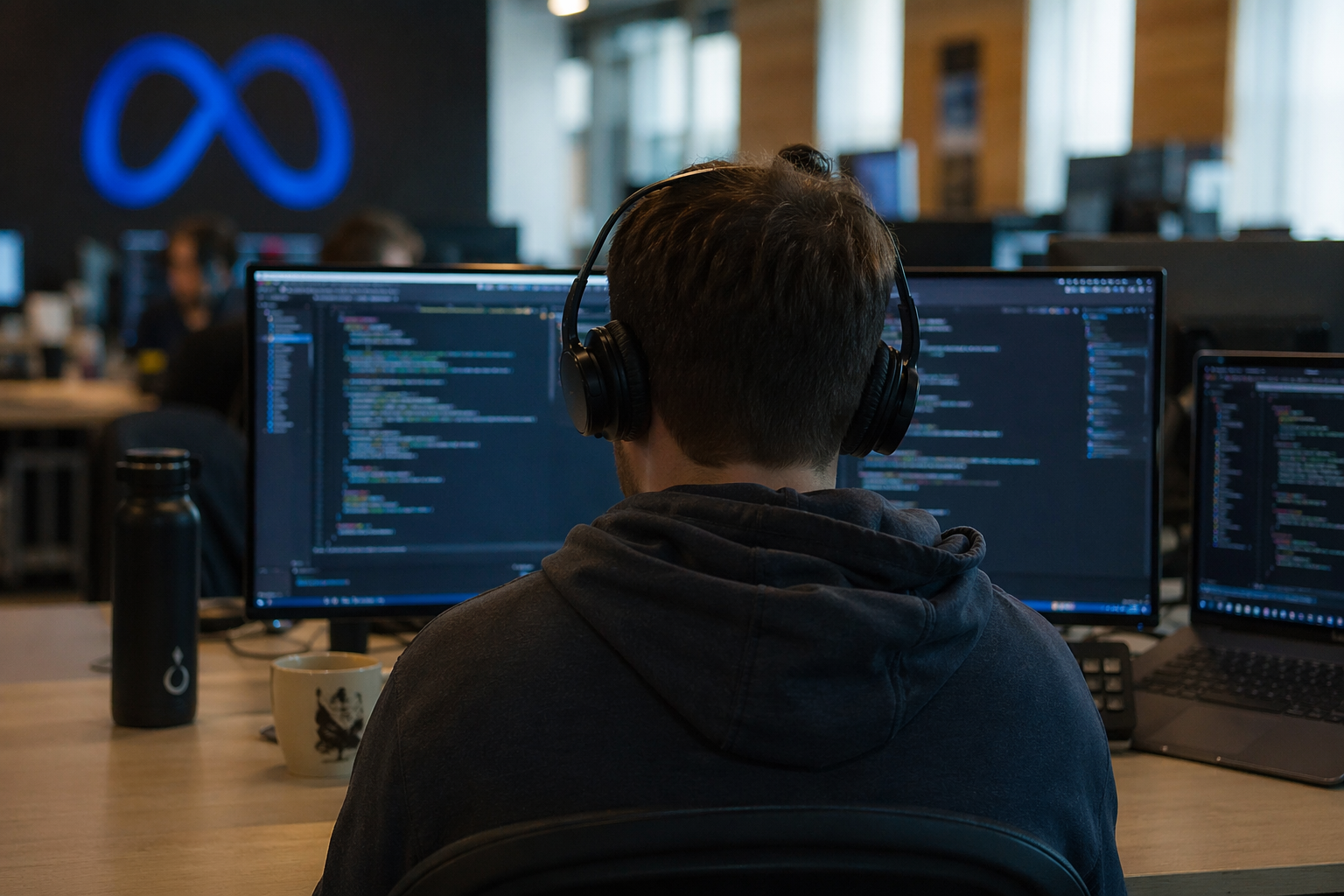
Meta is facing growing criticism after reports emerged claiming the company has introduced internal systems that require employees to help train artificial intelligence tools through monitored workplace activity.
The reports have sparked a wider debate about employee privacy, workplace surveillance, and the increasingly aggressive push by major technology companies to integrate AI into everyday operations.
As the global race for AI dominance intensifies, companies across the tech sector are investing billions into developing more advanced artificial intelligence systems. But Meta’s reported strategy suggests the company may be taking a controversial new step: using its own workforce as a large-scale source of behavioral training data for AI development.
Reports Reveal Internal Employee Monitoring Program
According to a report from The Verge, Meta has deployed internal software designed to track how employees interact with programs and digital tools on company-issued devices. The publication reported that the collected data may be used to train AI agents capable of automating workplace tasks and replicating human digital behavior.
According to The Verge, the monitoring system reportedly captures interactions such as clicks, cursor movements, workflow patterns, and how employees navigate software platforms. Meta reportedly argues that the system is intended to improve AI efficiency and help develop more advanced automation technologies.
The reports immediately triggered backlash online and internally among workers concerned about how much information the company could potentially collect from employees during daily work activities.
Employees Fear Long-Term Consequences
According to reporting from Business Insider, some employees expressed concerns internally that the collected data could eventually be linked to performance evaluations, productivity scoring, or future staffing decisions.
The report stated that several workers questioned whether AI systems trained on employee behavior could eventually replace parts of their own jobs.
Meta has reportedly denied that the monitoring program is intended for employee evaluation purposes. However, critics argue that once detailed workplace behavioral data is collected, concerns about future misuse become difficult to ignore.
Privacy experts say the controversy reflects a much larger shift happening inside the technology industry, where companies are increasingly searching for real-world human interaction data to improve AI systems.
Unlike publicly available internet data, workplace behavior provides highly structured information that can help AI systems learn how humans solve problems, navigate software, and complete complex digital tasks.
AI Adoption Becoming Mandatory Inside Tech Companies
The reports also highlight how AI usage is rapidly becoming a workplace expectation rather than an optional productivity tool.
People Matters reported that some engineering teams inside Meta have reportedly been encouraged to use AI-generated coding systems for a significant portion of their software development work.
The publication reported that some internal targets pushed teams toward generating most of their code through AI-assisted systems in an effort to improve productivity and accelerate development speed.
This reflects a growing trend across Silicon Valley, where executives increasingly view AI integration as necessary for remaining competitive.
Companies investing heavily in AI infrastructure are now under pressure from investors to demonstrate measurable productivity gains from those investments.
Read More: What Is End-to-End Encryption and Do You Actually Need It?
Performance Reviews Could Be Tied to AI Usage
Concerns intensified further after reports suggested AI adoption may eventually influence how employee performance is measured.
According to eWeek, Meta has explored ways to evaluate workers partly based on how effectively they use AI tools in their daily workflow.
The report suggested that employees who fail to integrate AI systems into their work processes could potentially fall behind in productivity expectations compared to workers who heavily rely on AI-assisted tools.
Labor experts warn that this kind of shift could fundamentally change workplace culture in the technology industry.
Instead of employees simply completing tasks themselves, workers may increasingly be expected to supervise, guide, and optimize AI systems while maintaining high productivity targets.
Growing Concerns Over Workplace Surveillance
Meta’s reported monitoring system has also intensified criticism surrounding workplace surveillance technologies.
Privacy advocates argue that systems capable of tracking employee digital behavior create serious ethical concerns, especially if workers are given little choice about participation.
Critics warn that if these practices become normalized inside major corporations, similar systems could eventually spread across other industries beyond the tech sector.
Some analysts believe the issue could become especially controversial in regions with stronger labor protections and stricter privacy laws.
According to an analysis published by PC Gamer, workplace monitoring systems tied to AI development may face regulatory scrutiny in regions such as the European Union, where employee data collection laws are often significantly stricter than in the United States.
Read More: Europe to Require Replaceable Phone Batteries by 2027
Debate Continues Over Whether AI Actually Improves Productivity
While companies continue promoting AI as a productivity revolution, some researchers remain skeptical about whether current AI systems consistently improve workplace performance.
A recent research paper published on arXiv found that experienced software developers using AI coding assistants sometimes completed tasks more slowly than developers working without AI tools.
Researchers suggested that reviewing AI-generated mistakes and correcting inaccurate outputs could reduce some of the expected productivity benefits.
The findings have fueled debate over whether companies may be pushing AI integration faster than the technology is truly ready for.
Meta’s High-Stakes AI Strategy
Meta has invested enormous resources into artificial intelligence development as it competes with rivals including OpenAI and Google in the race to dominate next-generation AI systems.
CEO Mark Zuckerberg has repeatedly emphasized AI as one of the company’s most important long-term priorities.
But the backlash surrounding these reports highlights the risks companies face when aggressive AI expansion begins affecting employee privacy and workplace autonomy.
For many workers inside the tech industry, the future appears increasingly clear: adapting to AI systems may no longer be optional.
And as corporations continue searching for new ways to train increasingly advanced artificial intelligence models, the line between employee productivity and employee data collection may become harder to separate.
For more society news and cultural reporting, visit the Society section at bdesk.news.

Michaela Reeds is an investigative journalist and reporter with a focus on politics, science, and technology. She brings clarity to complex issues, translating policy developments, scientific breakthroughs, and technological innovations into compelling stories for a broad audience. She is known for her dedication to accuracy, transparency, and in‑depth reporting.